
Microlearning: Short lessons, bigger impact
Microlearning is a need-driven, just-in-time delivery strategy (Monib et al, 2025) that most creators are already following. These short, focused trainings often result in better learning outcomes and higher student engagement (Oyeyipo et al, 2024).
Because professionals have little time for formal training – an average of 24 minutes a week (Josh Bersin, 2018) – succinct, on-demand lessons fit better into real work. Creator-guided learning fits this reality by:
- Offering short, actionable lessons that can be completed between tasks (also known as microlearning).
- Focusing on one skill or workflow at a time.
- Making training accessible on demand.
- Aligning directly with real tools and problems.
Authenticity and trust: Creators as credible educators
Trust is shifting away from major institutions and organizations (AAMC Center for Health Justice, 2025) and toward individuals who can prove their authority and expertise.
Creator content is grounded in real experience instead of academic abstractions. In industries where credibility is earned by doing (such as law, healthcare, and finance), creators are able to earn trust by showing their work publicly. This transparency is something universities and corporate HR/L&D departments cannot easily replicate.
Workflow-driven learning: Education that integrates
Creator-educators excel at teaching inside the workflow – showing the exact tools, scripts, and checklists they use. The 70/20/10 framework, an established L&D principle, suggests that professionals learn:
- 70% from hands-on, on-the-job experiences
- 20% from interactions with others
- 10% from formal instruction
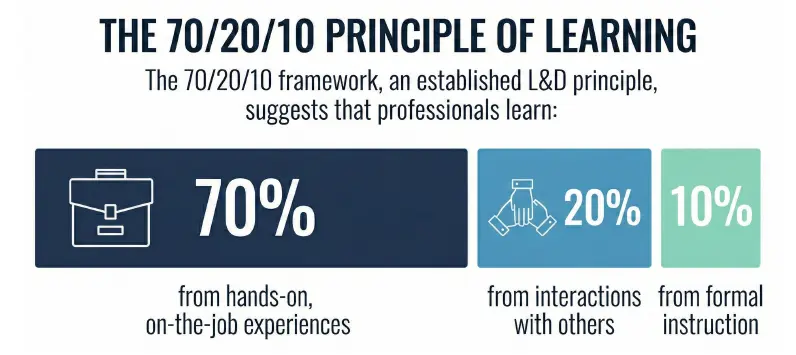
However, most professional development sits in the 10%.
Creators flip the model by teaching the skills professionals need directly within their tools and workflow.
Personalized training: Using AI for specialization and specificity
One of the biggest barriers to adult learning is that one-size-fits-all education rarely works, especially when learners have different levels of experience, operate in different roles, or use different tools. Agile creators are using AI to overcome this limitation by delivering personalized, role-specific training, such as:
- Workflow generators tailored to an industry.
- AI-graded practice that provides instant feedback.
- Scenario-based training modules designed around real-world conditions.
- Role-specific templates.
This is especially relevant since the OECD (2024) reports a rise in demand for “modular, self-directed, and work-integrated learning” – formats that AI makes easier to produce. Creators who use AI to personalize content are offering the kind of specialized instruction that traditional programs typically struggle to deliver.
👀➡️ ESSENTIAL READING | ‘The Skills Crisis Gold Rush: 4 Ways to Turn Your Expertise Into a 6-Figure Education Empire‘
What’s next for professional development?
The next era of professional development will be defined by specialized educators who can create and update learning at the speed of technology updates. As skill needs shift and more employers place value on capability over credentials, the demand for practitioner-led learning will accelerate.
This new approach to learning calls for more than courses. Professionals want role-specific, workflow-embedded, continuously updated education that keeps pace with a changing market.
The opportunity for creators
|
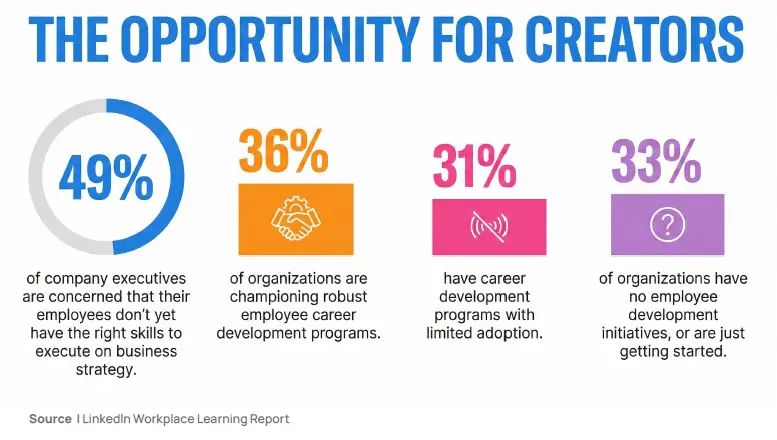
The following recommendations reflect where the skills economy is heading and what modern learners expect. To stay competitive in the skills economy, creator-educators should prioritize the following strategies.
👀➡️ ESSENTIAL READING | ‘How to Sell Digital Products in 2026: A Step-by-Step Guide’
1) Build for skills evidence, not course completion
Nearly two-thirds of employers now use skills-based hiring to identify potential candidates (Gray, 2025). Skills-first evaluation means your learning products must provide proof: portfolio artifacts, workflow simulations, tool-based assessments, and measurable demonstrations of competence.
2) Narrow your focus to a clear niche
Highly specific skills are becoming more valuable as professionals look for training tailored to their exact tools, workflows, and industry demands. Choose a specific profession, workflow, or tool and go deep. Specialized training is easier to market, easier to update, and more valuable to professionals.
3) Integrate training directly into workflows
Working professionals don’t have time for training that isn’t immediately applicable. Microlearning formats – short lessons with direct application – have an average completion rate of 80%, compared to just 30% for long-form modules (eLearning Industry, 2025).
4) Use AI to scale, personalize, and continuously update your products
AI is reshaping how digital learning is produced, delivered, and maintained. Use AI to:
- Streamline content creation
- Personalize learning paths
- Update modules as tools change
- Generate practice scenarios and assessments
- Expand from one core course into an ecosystem of micro-products
5) Collaborate with the tools and companies professionals already use
Partnering with software companies, professional associations, or industry groups gives your content immediate credibility. It also ensures you’re teaching skills that employers are actually looking for.
6) Share your expertise publicly
Research from Edelman (2024) shows that 73% of decision-makers trust thought leadership more than your marketing material when determining your true capabilities. Regular articles, videos, and unique insights build your reputation as a trusted voice, establish authority, and attract the right learners.
👀➡️ MORE FROM THE BLOG | ‘How to Increase Checkout Conversion Rates: 12 Strategies‘
Closing perspective
The landscape of professional learning is transforming, and creator-educators are in a unique position to lead that change. They are close to the tools, workflows, and real-world challenges that professionals struggle with every day – an advantage that traditional learning institutions simply don’t have.
As the modern workforce continues to evolve, the most valuable professional learning experiences will come from practitioners who can turn their expertise into actionable skills, update content the moment tools change, and deliver training that feels practical and relevant. Creator-educators who step up to the challenge – and the AI tools that amplify their reach – are creating the new blueprint for professional development.
Want to know more? ThriveCart has all the tools you need to build and scale your business, helping you grow from side-hustle to start-up to six- and seven-figure passive income.

This article is an extract from our full white paper, ‘The New Skills Economy: How Creators Are Redefining Specialized Professional Learning’. For a deeper dive, including case studies from creators in the field, download it today.