Top 10 Subscription Management Software Tools in 2026 (SMB & SaaS)
Last Updated: October 30, 2026

Subscription services are everywhere these days. We subscribe to watch movies, stream music, learn new skills, and access tools we use daily, making recurring payments a normal and expected part of modern life.
Offering subscriptions to your customers is no longer optional. As a business owner with a subscription model, you need reliable subscription management tools that can handle billing, track customer activity, manage pricing models, and support accurate financial reporting. With 68% of consumers still loyal to the brands they regularly buy, even if prices increase, subscription-driven businesses are here to stay.
What is the best subscription management software? It depends on your stage and pricing model. ThriveCart suits creators and small teams selling courses or memberships. Billsby and Stripe Billing suit lightweight starts. Chargebee, Maxio and Zuora suit SaaS teams with usage-based or hybrid pricing. Compare all 10 below, or jump to what you need when launching, flexible pricing and preventing missed renewals.
| Tool | Best for | Pricing | Usage-based billing | Dunning or retries |
|---|---|---|---|---|
| ThriveCart | Creators and small teams | $495 one-time (Standard); Pro+ $295/year after year one | — | Yes |
| Billsby | Small businesses starting out | Free plan; Core $45/mo; Pro $135/mo | Yes | Yes |
| Chargebee | SaaS with complex pricing | Free up to $250K annual revenue, then 0.75%; Performance $7,188/year | Yes | — |
| Maxio | SaaS with usage-based plans | Grow $599/mo; Scale custom | Yes | Yes |
| FastSpring | Selling globally with tax handled | Revenue share or custom | — | — |
| Paddle | Merchant of record for multi-country SaaS | 5% + $0.50 per checkout | — | — |
| Recurly | Flexible plans and retention | Custom or usage-based (contact sales) | — | Yes |
| Stripe Billing | Teams building custom workflows | 0.7% of billing volume + Stripe fees | Yes | Yes |
| Zoho Subscriptions | Budget-friendly SMBs, Zoho users | Standard $29/mo; Premium $69/mo | — | Yes |
| Zuora | Enterprise | Custom | Yes | — |
How we picked: we looked at the nine core features listed below (billing models, automation, dunning, lifecycle, self-service, analytics, tax, integrations, scalability). A dash means the feature isn’t listed in that vendor’s summary in this post, so check the vendor for current details. Pricing as of October 2026.
Key takeaways:
- The best subscription management solutions simplify subscription billing, automate invoicing, and handle failed payments to ensure your monthly recurring revenue remains steady.
- Modern platforms support multiple pricing models, including tiered and usage-based, for easier management of complex customer subscriptions.
- Automation features and detailed analytics help lessen customer churn for long-term financial health.
Seize this chance to start selling your subscription-based products on ThriveCart now!
Key features of subscription management software
Not all subscription tools are built the same. The best subscription management software goes beyond charging customers every month to help you automate operations, reduce churn, and scale recurring revenue with confidence. When evaluating a platform, these are the nine core features that matter most:
1) Flexible billing models
A strong subscription platform should support multiple pricing structures, including flat-rate plans, tiered pricing, usage-based billing, and hybrid models. This flexibility enables you to adjust your offers as customer needs change.
2) Automated recurring billing and invoicing
Reliable automation ensures customers are billed on time without manual effort. Invoicing, receipts, and payment confirmations should be handled automatically to reduce errors and save time.
3) Dunning and failed payment recovery
Failed payments are inevitable. Subscription software should include smart retry logic, automated reminders, and payment update prompts to recover lost revenue and minimize involuntary churn.
4) Subscription lifecycle management
From sign-ups and free trials to upgrades, downgrades, pauses, and cancellations, a good platform manages the entire subscription lifecycle smoothly, often with prorated billing handled automatically.
5) Customer self-service portals
Giving subscribers the ability to manage their plans, update payment methods, and view billing history improves customer experience and reduces support workload.
6) Analytics and reporting
Clear visibility into key metrics like monthly recurring revenue (MRR), churn rate, lifetime value (LTV), and retention trends help you make smarter growth decisions.
7) Tax and compliance support
For businesses selling across regions, built-in tax calculation, VAT/GST handling, and compliance tools can prevent costly mistakes and administrative overheads.
8) Integrations and automation
Subscription software should connect seamlessly with email marketing tools, CRMs, accounting systems, analytics platforms, and fulfillment tools to keep your entire stack in sync.
9) Scalability and pricing transparency
As your business grows, your subscription platform should scale with you, without unpredictable fees, excessive complexity, or forced upgrades you don’t need.
→ YOU MIGHT ALSO LIKE | ‘7 Best Subscription Website Builders’
10 subscription tools to simplify billing and growth
Whether you’re monetizing your expertise through courses, coaching, or memberships, the right subscription management platform removes the friction from recurring payments, so you can focus on creating and selling, not managing billing.
We’ve listed the top 10 subscription management software for your consideration in 2026.
1) ThriveCart (Best overall for SMBs and digital creators)
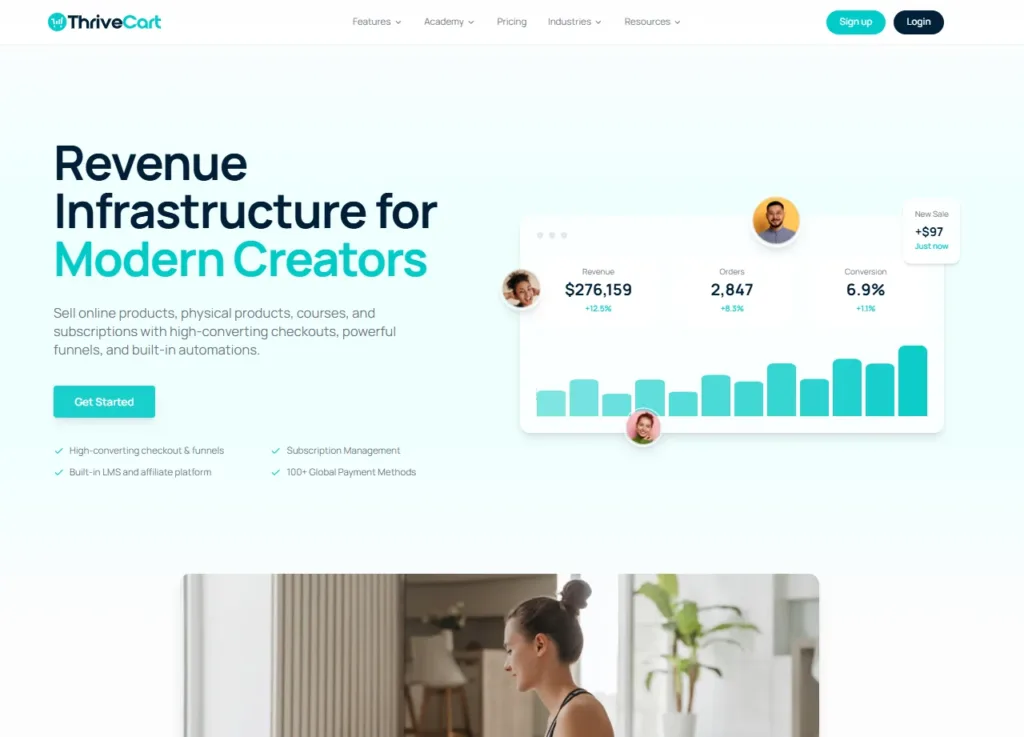
ThriveCart is designed for entrepreneurs and businesses seeking straightforward, automated subscription billing. It streamlines payment collection and subscription plan management for companies that sell digital goods or services. It’s the perfect solution for businesses selling multiple subscription types.
→ Also weighing SamCart for subscriptions? Our ThriveCart vs SamCart comparison covers billing, upsells, and pricing side by side.
Pricing:
- Standard lifetime license: $495 one‑time payment – includes core cart and subscription billing features.
- Pro+ upgrade: $295 annual (after first year)
Here’s why it stands out:
- Recurring billing and payment plans: ThriveCart helps you create subscription products with monthly or annual payment schedules, including free trials and paid options.
- Subscription lifecycle automation: ThriveCart handles upgrades, downgrades, cancellations, and prorated billing to ensure plan changes happen smoothly.
- Subscription metrics: Track recurring revenue performance, including churn retention and lifetime value, on your dashboard.
- Limited recurring billing options: Offer payment plans that stop after a number of cycles to give customers predictable end-dates.
Why it’s worth considering:
ThriveCart currently employs a one-time pricing model, rather than subscriptions, making it an affordable and straightforward option for creators, small teams, and agencies.
→ RELATED READING | ‘How to Sell Digital Products in 2026: A Step-by-Step Guide’
2) Billsby

Billsby provides subscription management with tiered pricing for small to mid-size businesses (SMBs) and includes a free tier with basic features. Its plans scale with usage and offer flexible billing and customer lifecycle automation.
Pricing:
- Free plan available
- Core $45/month (plus 0.4% on revenue exceeding $15,000/mo)
- Pro $135/month (plus 0.5% on revenue exceeding $30,000/mo)
- Custom – bespoke pricing
Features:
- Recurring billing cycles
- Usage (metered) billing
- Custom pricing plans
- Automated dunning management
- Reporting and insights
Why it’s worth considering:
Billsby is a practical starting point for small businesses that want flexible subscription billing without a large upfront commitment. Its free tier and usage-based pricing can be helpful for teams experimenting with subscription models.
3) Chargebee

Chargebee manages subscription billing, analytics, and tax compliance for SaaS businesses. It supports multiple pricing models and integrates with accounting, CRM, and payment platforms.
Pricing:
- Starter: Free up to $250K annual revenue, then 0.75% of billing volume
- Performance: $7,188/year
- Enterprise: Custom quote
Features:
- Multiple pricing models (tiered, usage-based, hybrid)
- Analytics for customer behavior and lifetime value
- Integration options
- Billing and tax compliance automation
Why it’s worth considering:
Chargebee supports SaaS companies with complex pricing and global customers. Its analytics, tax tools, and integrations could be useful for businesses that need structured subscription operations as they grow.
→ MORE FROM THE BLOG | ‘9 Best Payment Gateways for Your Business’
4) Maxio (previously Chargify)

Maxio is a subscription billing platform used by SaaS businesses that offer recurring and usage-based plans. It supports automated billing, customer self-service, and subscription reporting.
Pricing:
- Grow: $599/month (includes up to $100K in monthly billings)
- Scale: Custom pricing
Features:
- Usage‑based and recurring billing support
- Customer self‑service portals
- Automated invoicing
- Dunning and payment collection logic
- Subscription data and reporting
Why it’s worth considering:
Maxio is built for SaaS businesses that use usage-based billing and require detailed financial reporting. It’s often chosen by teams that need deeper visibility into recurring revenue as they scale.
5) FastSpring

FastSpring is a subscription and ecommerce platform with global payment and tax compliance included in its model. Pricing is generally based on a revenue share or custom enterprise agreements rather than flat fees.
Pricing: Pay‑as‑you‑go with revenue share or custom enterprise terms
Features:
- Subscription plan creation
- Free trial to paid conversion flows
- Coupon and discount support
- Automatic payment notifications
- Customer self‑service portal
Why it’s worth considering:
FastSpring helps businesses sell internationally by managing payments, taxes, and compliance within a single system. Its revenue-share pricing can suit companies that prefer to minimize upfront software costs.
6) Paddle

Paddle functions as a merchant of record billing solution where pricing is transaction‑based and includes payment, tax, and compliance handling. It consolidates legal and tax obligations into platform fees rather than separate modules.
Pricing: Pay as you go (5% + $0.50 per checkout transaction)
Features:
- Merchant of record billing
- Global tax calculation and remittance
- Recurring and one‑time payments
- Compliance and fraud handling
- Checkout and payment routing
Why it’s worth considering:
Paddle acts as the merchant of record, which simplifies tax, compliance, and legal requirements. This can be particularly helpful for SaaS companies that sell across multiple countries.
→ HANDPICKED FOR YOU | ‘How to Launch a Profitable High-Ticket Course’
7) Recurly

Recurly handles subscription billing for businesses with flexible or complex plans. It includes automated invoicing, multiple payment gateways, and tools for churn management.
Pricing: Starter options with custom or usage‑based pricing (requires sales contact)
Features:
- Flexible plan management (active, paused & canceled)
- Automated recurring billing and invoicing
- Multiple gateways and global payments support
- Churn and recovery tools
- Customer account portals
Why it’s worth considering:
Recurly focuses on subscription flexibility and retention. Its churn management and payment recovery features support businesses with evolving subscription offerings.
8) Stripe Billing

Stripe Billing uses a pay‑as‑you‑go model tied to Stripe payment transactions and can be combined with Stripe Payments for full payment processing. It requires technical integration for custom subscription workflows.
Pricing: Pay as you go: 0.7% of billing volume (plus standard Stripe transaction fees)
Features:
- Recurring and usage‑based billing logic
- Proration and smart retries
- Built‑in customer portal
- API for custom workflows
- Integration with the Stripe ecosystem
Why it’s worth considering:
Stripe Billing could work well for teams with resources that want to build custom subscription workflows. It integrates naturally with the broader Stripe ecosystem.
9) Zoho Subscriptions

Zoho Subscriptions offers subscription and billing management with affordable tiered pricing and integration within the Zoho ecosystem. Plans support both recurring and one‑time billing workflows.
Pricing:
- Standard: $29/month (per organization per month)
- Premium: $69/month (per organization per month)
- Enterprise (custom pricing)
Features:
- Automated recurring billing
- Dunning and proration
- Subscription analytics
- Customer portal
- Payment gateway integrations
Why it’s worth considering:
Zoho Subscriptions offers a straightforward and budget-friendly option for small to mid-sized businesses. It’s especially convenient for teams already using Zoho’s CRM and business tools.
10) Zuora

Zuora is a subscription management platform designed for enterprise use with custom pricing quotes. It emphasizes enterprise billing and revenue automation across complex pricing and compliance structures.
Pricing
- Enterprise pricing (custom)
Features:
- Flexible billing models (usage, hybrid & one‑time)
- Revenue recognition and accounting support
- API and integration tools
- Automated billing schedules
- Enterprise reporting tools
Why it’s worth considering:
Zuora is designed for enterprise organizations with complex billing, compliance, and revenue recognition needs. It’s commonly used by large, global subscription businesses.
→ FOR YOU | ‘16 Tips to Streamline Your E-commerce Checkout Experience’
Make checkouts simple for every buyer.
Why adopt the subscription model for your business?
A subscription model can change how your business earns, grows, and interacts with your customers. One-time sales can be unpredictable, and relying on them may not be a good idea.
Subscriptions generate steady, recurring income, solidifying your cash flow. In return, you need to give customers your best products, so every buck they pay is worth the risk. In some ways, subscriptions deepen customer relationships, giving your brand long-term engagement.
Here’s how the subscription model impacts your business:
- Predictable revenue helps you plan better financially.
- Clients stay longer and renew automatically due to the quality of products and services.
- Subscribers are more invested in your products and services the longer they subscribe.
- Opportunities for upsells and add-ons.
Subscriptions also give you a better understanding of customer behavior. You can refine your offerings based on how they react to every product you release.
So whether it’s digital content, membership perks, or software, a subscription-based system helps your business grow and foster customer loyalty for the long haul.
How do I select the best subscription management platform?
The right platform for your business is largely determined by your subscription models, revenue goals, and technical requirements. Evaluate your options with these tips:
Your subscription structure
Do you offer simple monthly plans or do you have multi-tier offerings? Each of these subscription models has its own structure, so choose a tool that can accommodate them.
Your operational needs
You may need automated invoicing, payment collection, and revenue accounting. If you have multiple subscriptions per customer, minimize your headaches by choosing a tool that can handle that kind of model.
Your growth stage
Your company’s size and growth trajectory also play a role in selecting a subscription management platform. Early-stage startups and solo operators often benefit from lightweight tools like Billsby or Stripe Billing, which offer flexibility and lower upfront costs.
→ RECOMMENDED READING | ‘Building Customer Loyalty with ThriveCart: Retention Strategies That Work’
What software do I need if I’m launching subscriptions?
You need recurring billing, automated invoicing, failed-payment recovery and a customer self-service portal. Early-stage teams often start with ThriveCart, Billsby, Zoho Subscriptions or Stripe Billing, then look at platforms like Chargebee or Maxio as pricing gets more complex.
Which subscription management software supports flexible pricing, including hybrid and usage-based?
Chargebee and Zuora list hybrid pricing, and Billsby, Maxio, Stripe Billing, Chargebee and Zuora support usage-based (metered) billing. Compare them below.
What is hybrid pricing?
Hybrid pricing combines a fixed recurring fee with usage-based charges. Chargebee and Zuora list hybrid models among their supported pricing options.
How does usage-based billing work?
Usage-based (metered) billing charges customers according to how much they use, instead of a flat amount each cycle. Billsby, Maxio, Stripe Billing, Chargebee and Zuora support it.
| Tool | Usage-based (metered) | Hybrid | Other flexible options |
|---|---|---|---|
| Billsby | Yes | — | Custom pricing plans |
| Chargebee | Yes | Yes | Tiered pricing |
| Maxio | Yes | — | — |
| Stripe Billing | Yes | — | API for custom workflows |
| Zuora | Yes | Yes | One-time billing |
Which software prevents missed renewals and involuntary churn?
Look for dunning: smart payment retries, automated reminders and payment-update prompts, plus a customer portal where subscribers can fix their own card. ThriveCart, Billsby, Maxio, Recurly, Stripe Billing and Zoho Subscriptions all list dunning or recovery tools.
What is involuntary churn?
Involuntary churn is when a subscriber is lost because a payment fails, not because they chose to cancel. Dunning tools recover many of these payments through retries, reminders and payment-update prompts.
How does software prevent missed renewals?
It retries failed payments automatically, sends reminders and payment-update prompts, and lets subscribers update their payment method in a self-service portal. Together these recover payments before the subscription lapses. See dunning and failed payment recovery above.
- Smart payment retries
- Automated reminders
- Payment-update prompts
- Self-service payment-method updates
- Churn and retention reporting
Which tools offer dunning and failed-payment recovery?
| Tool | Dunning or retries | Self-service portal |
|---|---|---|
| ThriveCart | Automated dunning | — |
| Billsby | Automated dunning | — |
| Maxio | Dunning and payment collection logic | Yes |
| Recurly | Churn and recovery tools | Yes |
| Stripe Billing | Smart retries | Yes |
| Zoho Subscriptions | Dunning | Yes |
| FastSpring | — | Yes |
How do I simplify subscription management?
Consolidate billing, invoicing, failed-payment recovery, plan changes and customer self-service in one platform. Choose a tool that automates upgrades, downgrades, pauses and proration, and gives subscribers a portal to update payment details, so you stop handling these tasks manually.
What is the best subscription platform for professionals?
For coaches, course creators and consultants, ThriveCart is built for the job: recurring billing, free trials, payment plans, dunning and subscription metrics with minimal technical setup. Enterprise-focused tools like Zuora and Chargebee suit larger SaaS billing needs instead.
Digital creators and small teams selling courses, memberships, or digital products may find ThriveCart especially practical, as it provides built-in subscription management with a one-time pricing model and minimal technical setup. And if you’re a digital creator, whether it’s an online course or a digital product, ThriveCart works best for managing your audience’s subscriptions.
Choosing the right subscription management platform plays a crucial role in how efficiently your business runs, scales, and sustains recurring revenue. From simple monthly plans to advanced billing structures, reliability, payment recovery, and accurate reporting are essential for long-term success.
ThriveCart brings all of this together in one powerful, conversion-focused platform. With built-in automated dunning, seamless subscription management, and clear revenue tracking, ThriveCart helps you reduce churn and recover lost payments effortlessly. As subscription-based businesses continue to grow, ThriveCart empowers you to strengthen customer loyalty, streamline operations, and maximize recurring revenue with confidence.
Frequently asked questions
What is the best subscription management software?
It depends on your stage and pricing model. ThriveCart suits creators and small teams selling courses or memberships. Billsby and Stripe Billing suit lightweight starts. Chargebee, Maxio and Zuora suit SaaS teams with usage-based or hybrid pricing. Compare all 10 below.
What software do I need if I’m launching subscriptions?
You need recurring billing, automated invoicing, failed-payment recovery and a customer self-service portal. Early-stage teams often start with ThriveCart, Billsby, Zoho Subscriptions or Stripe Billing, then look at platforms like Chargebee or Maxio as pricing gets more complex.
Which subscription software supports hybrid and usage-based pricing?
Chargebee and Zuora list hybrid pricing, and Billsby, Maxio, Stripe Billing, Chargebee and Zuora support usage-based (metered) billing. Compare them below.
What is involuntary churn?
Involuntary churn is when a subscriber is lost because a payment fails, not because they chose to cancel. Dunning tools recover many of these payments through retries, reminders and payment-update prompts.
How do I simplify subscription management?
Consolidate billing, invoicing, failed-payment recovery, plan changes and customer self-service in one platform. Choose a tool that automates upgrades, downgrades, pauses and proration, and gives subscribers a portal to update payment details, so you stop handling these tasks manually.

Jared Orlin
Jared Orlin is a senior content leader with over 15 years of experience driving content strategy, brand storytelling, and digital marketing across the U.S., UK and South Africa. As ThriveCart's Content Manager, he works with internal teams, including Leadership, Product, Engineering, Customer Service, and Support, to create clear messaging and updates around product updates, creator how-to guides, industry trends, and customer success stories. Follow Jared on LinkedIn.