

Kelli Mitchell didn’t set out to build a complicated online business.
She simply wanted to teach women how to turn their creative skills into income. Today, her business, Pink Lemonade Company, helps women learn digital art through Photoshop and Procreate, then shows them how to monetize their ideas and build more flexible lives around their creativity.
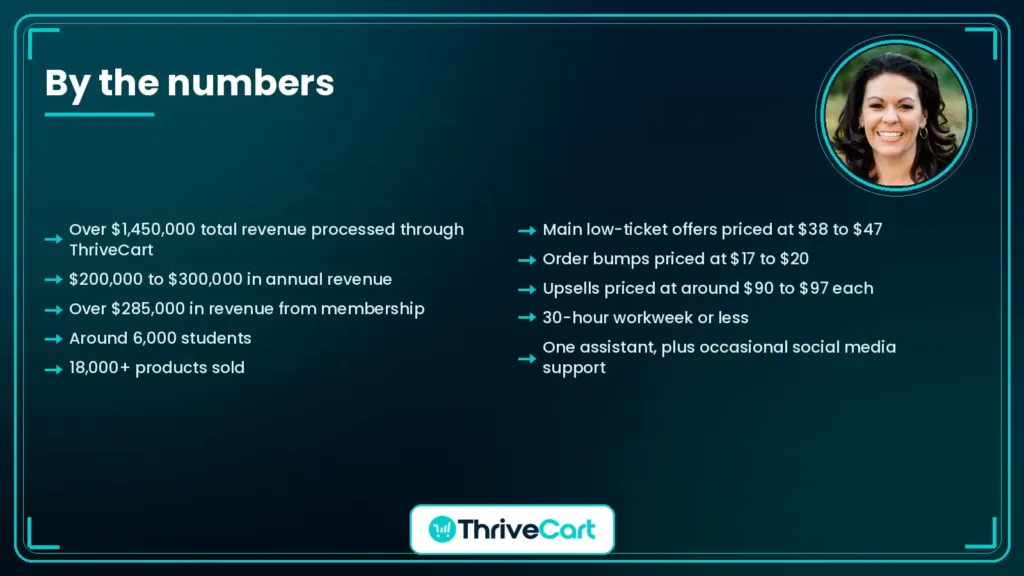
The business now brings in between $200,000 and $300,000 a year, with around 6,000 students. But Kelli’s biggest win isn’t just revenue. It’s building up a business that supports her life instead of taking it over.
By shifting toward low-ticket offers, strategically using upsells and order bumps, and consolidating her tech stack around ThriveCart, Kelli has created a simpler sales process that can turn a $47 course purchase into an order worth around $260.
She’s also been able to step back from the day-to-day running of the business and keep her workweek to 30 hours or less. As Kelli puts it, “The real lens of success for me is being able to work no more than 30 hours a week.”
Here’s how she does it.
From digital art to a business that supports women
Kelli stepped away from a high-stress job as a respiratory therapist, often working 12-hour shifts and barely seeing her children, to start Pink Lemonade Company in 2011. At first, her work focused on website design and branding. But as more women asked how she was making a living from her creative work, she saw an opportunity to teach them what she knew. Her membership, PLC Insiders, ($197 for three months or $297 for six months) includes courses, tutorials, and downloadable graphics and designs with commercial reuse licenses. She also has stand-alone courses.

“I teach women digital art primarily through learning Photoshop or Procreate,” she explains. Her students don’t just learn how to make something look good. They learn how to use those skills to create products, offer services, and earn money from their ideas. As Kelli puts it, “I teach them how to monetize their ideas and make money from their creativity.”
Many of the women Kelli works with have family lives and are already stretched thin. They may want to earn more money, but they don’t have endless time, energy, or resources to invest in a new business. Kelli understands that pressure because she’s built her own business through a series of changes rather than one huge overnight transformation.
“I don’t think it was necessarily one pivot,” she says. “It’s been several small pivots over the years.” That willingness to keep adjusting has helped her find a model that works better for both her customers and her own lifestyle.
→ READ MORE SUCCESS STORIES | ‘From Burnout to $3 Million: How a Photographer Quit Her Camera and Built a Coaching Empire With ThriveCart‘
ThriveCart as the hub of a successful tech stack
By using ThriveCart for checkout, payment options, upsells, order bumps, and course access, Kelli has reduced the number of separate systems she needed to manage. “It’s just all a seamless process. It’s freed up a lot of mental energy and time,” she says. “I don’t want to run my business just to pay the bills and be a slave to my business. I want to have a life completely outside of that and have my business running in the background. And with ThriveCart, I feel like that’s possible because everything’s just automated – it’s a system that runs in the background while I go and live my life.”
The change also gave her a clearer view of what was happening in the business. Kelli can check checkout conversion rates and daily revenue from her phone, rather than waiting for several different platforms to update or trying to piece together information from different dashboards.
That visibility matters when you’re running a lean business. Kelli has one assistant and occasional social media support, so she doesn’t have a large team available to monitor every technical detail.
ThriveCart also helped Kelli rethink where her courses live. She’s now moving courses from Teachable to ThriveCart Academy, which removes another disconnected platform from the process. The move was especially important after Teachable told her that pricing would increase to approximately $880 a month based on her courses and student numbers. That would have added roughly $10,560 a year to her platform costs. Kelli didn’t want to pass that increase on to her customers, nor did she want to absorb it herself. “I don’t have the margins to cover it,” she explains. “It just left a really bad taste in my mouth and I was like ‘I don’t want to be with them anymore’. Around the same time is when ThriveCart Academy was introduced and I knew it was a natural fit for us.”
Moving away from that price increase helped Kelli protect her margins and save thousands in potential annual platform fees. It also gave her a course-delivery option that fits more naturally with the rest of her ThriveCart setup, which still integrates with Kit for emails and Wishlist Member for membership management.
→ SEE HOW A CONSOLIDATED TECH STACK REALLY WORKS | ‘How a Self-Taught Mindset Mentor Consolidated 7 Separate Tools Into ThriveCart & Built a $2 Million Business‘

Turning a $47 sale into a $260 order
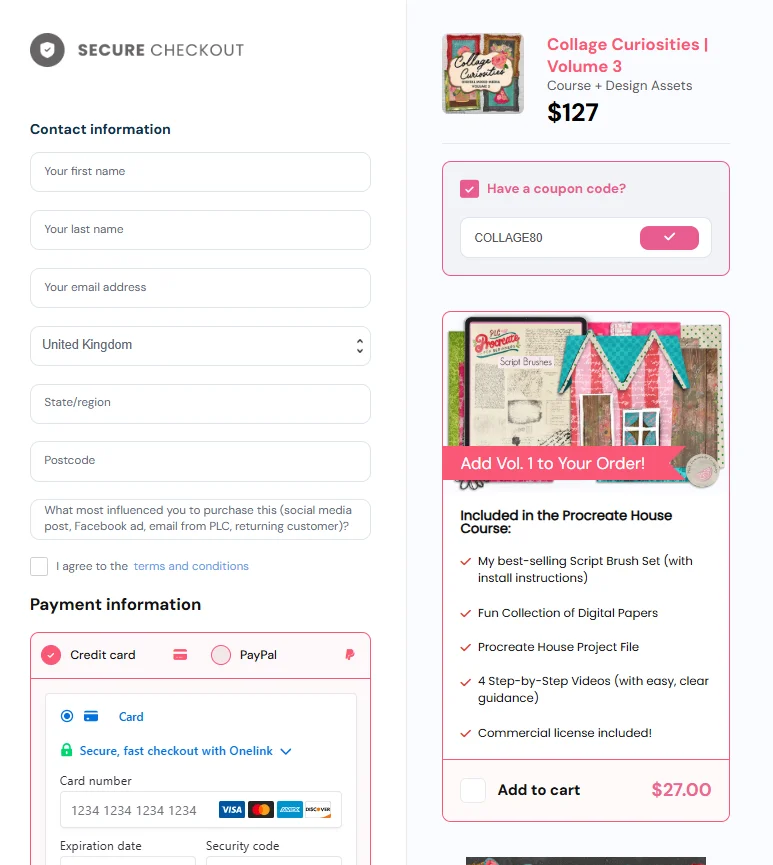
One of the clearest ways ThriveCart has helped Kelli grow revenue is through order bumps and upsells. Her typical funnel starts with a low-ticket product priced between $38 and $49. Customers can then add a $17 to $20 order bump before completing their purchase. After that, they may see two upsells, usually priced between $90 and $97 each.
It’s a simple structure, but it gives customers more ways to get the help or resources they need.
For Kelli, the difference in order value can be significant. A customer who arrives through a Facebook ad for a $47 course may go on to purchase additional products, creating an order worth around $260. “We can turn that automatically into an order that looks more like $260 versus $47,” Kelli explains.
For example, Collage Curiosities, which launched in October 2025, is a low-ticket product that sells for $48. It includes an order bump and two upsells, and has made Kelli $42,384. The order bump has a 24% conversion rate and has brought in an additional $4,000, while the upsells each have an 8% conversion rate and have brought in an additional $7,580. “Without ThriveCart’s order bump and upsells, I would have missed out on $11,580 in revenue,” Kelli says.
Kelli tracks average order value and checkout conversion rates through the ThriveCart dashboard so she can see whether her offers and ads are working. She doesn’t have to create a complicated sales process or personally recommend every additional product. The checkout does the work automatically.
For a business built around cold traffic and low-ticket offers, that matters. The additional revenue from bumps and upsells can help offset advertising costs, making it easier to continue testing new products and bringing more people into the business.
→ JUST FOR YOU | ‘From Passion Project to 7 Figures in a Year: How Chris Huntley Built a Recurring Revenue Empire With ThriveCart‘
Kelli’s advice for entrepreneurs and coaches
 Kelli’s experience has taught her that building a successful online business doesn’t require having every detail figured out before getting started.
Get out of your own way
Her first piece of advice is simple: “Number one would be get out of your own way,” she says. It’s easy to keep waiting for the perfect idea, the perfect website, or the perfect plan. But waiting can become a habit that stops a good idea from ever becoming a real business.
Start with one small idea
“Start small,” she recommends. “Start with one small idea and you can build it out from there.”
That advice works particularly well for coaches, creators, and digital product sellers. You don’t need to launch a huge program or create a dozen products at once. Start with something that solves one problem for one type of customer. Then listen, improve, and expand.
Choose the right systems earlier
Kelli also wishes she’d found a simpler setup sooner. “If I could have found ThriveCart five years prior, honestly, it would have saved me a lot of time and money and struggle,” she says. The lesson is to think about the customer journey early. How will people pay? How will they receive what they bought? What happens if they want to add another product or cancel? Which parts can happen automatically?
The right tools can help you answer those questions before your business becomes difficult to manage. Kelli’s recommendation for people considering ThriveCart is straightforward: “I would tell them to go for it.”
→ READ A SIX-FIGURE SUCCESS STORY | ‘Simple By Design: How Lindsay Maloney Escaped the Launch Grind and Built a Multi-6-Figure Business With ThriveCart‘
