
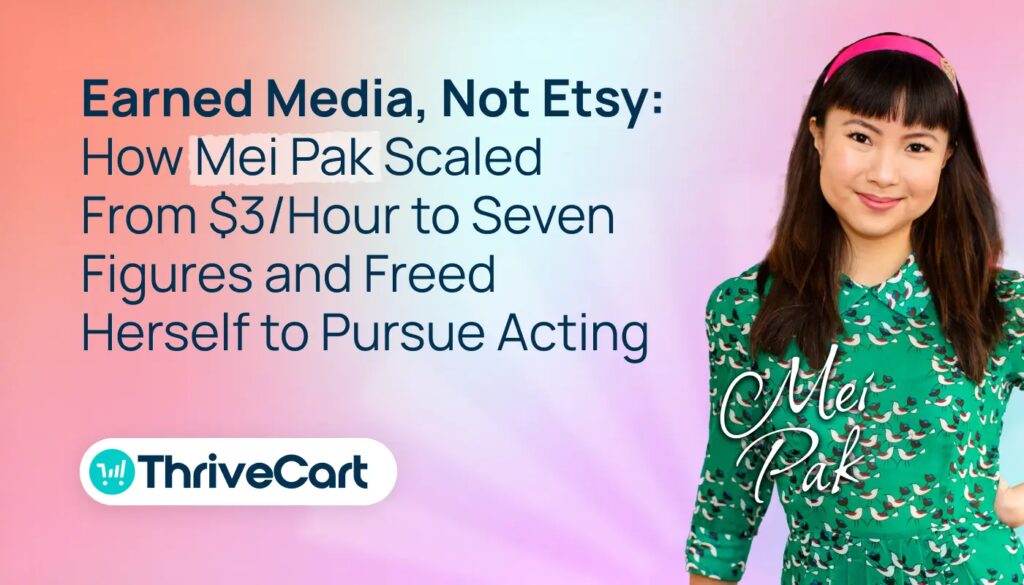

If Mei Pak’s story sounds just like a fairy tale, we totally get it: a young woman from Malaysia moves to Wisconsin to study math, brings a suitcase full of craft supplies, starts making $3 an hour selling handmade jewelry, and somehow ends up running three businesses, helping her husband quit his programming job, and pursuing her acting dreams.
But here’s the thing – it’s not a fairy tale. It’s the result of a very deliberate, very counterintuitive philosophy – one that flies in the face of almost everything the online business world tells creators to do.
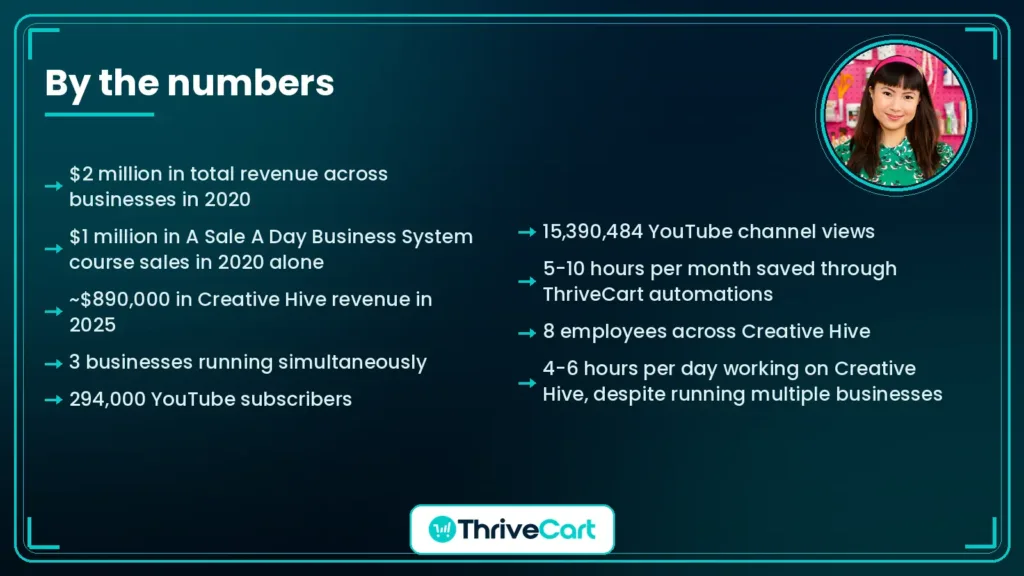
Mei doesn’t build her audience on Instagram. She doesn’t rely on Etsy to sell her products. And she doesn’t chase complexity. What she does instead has helped her scale Creative Hive, her coaching business for makers and artists, to a million-dollar launch in 2020, a combined $2 million across her businesses that same year, and around $890,000 in Creative Hive revenue in 2025 alone.
Here’s the story – and the strategy behind it.
The earned media breakthrough
When people started featuring Tiny Hands organically on their blogs and websites – plus in Rachael Ray magazine and on the TV sitcom Parks and Recreation, Mei noticed something. Every feature sent a surge of traffic and sales – and not just in the first week. That traffic kept coming.
“No one told me to do this thing,” she says. “Of course, my next question was: how do I do this on command?”
She taught herself to pitch to media, collaborated with influencers, and borrowed the audiences of people who already had the attention of her ideal customers. The results were so strong that she launched Creative Hive in 2014 specifically to teach other artists and makers the same approach – one she refers to as the “earned media tactic.”
The philosophy is simple: instead of slowly building your own social following from zero, find people who already have your audience and get in front of them. “I always remind people that social media is not the only way to make an income online,” she says. “It might be the easiest way to get started. But it’s not the best ROI you can get for your time.”
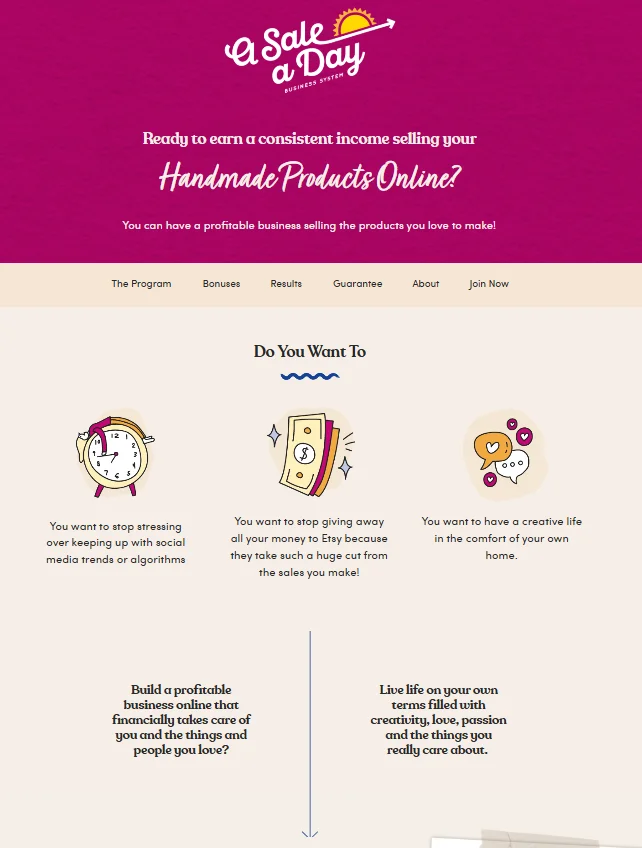
Her flagship course, A Sale A Day Business System (priced between $1,997-$3,016), is built entirely around this model, teaching creators how to get pitch-ready and then get featured.
→ YOU MIGHT ALSO LIKE | ‘The 4-Day CEO: How Winnie Wu Runs Multiple 7-Figure Businesses With ThriveCart‘
Why Etsy isn’t the answer
Mei has a strong view on Etsy as a platform for selling physical products – and she’s not shy about sharing it. Her core message to the thousands of artists she coaches is this: don’t build your business on a platform you don’t control.
“Don’t put all your eggs in the Etsy basket,” she says. “There’s so much you cannot control. It’s algorithm-based. It can change on you overnight.”
Her conviction got some unexpected personal reinforcement when her husband Peter started testing his own Etsy shop. “One year he made all this money on Etsy, so he decided the year after to do all these improvements, thinking it was going to be great,” she says. “And then it didn’t. Every single idea he had flopped.”
The lesson wasn’t that Peter did something wrong. It was that Etsy, like so many marketplace platforms, is inherently unpredictable. For anyone trying to build a stable, sustainable income, that’s a shaky foundation to stand on.
What Mei advocates instead is selling through channels you own and control – your own website, your own checkout, your own email list – using earned media to drive the traffic. It’s a model that’s less flashy than going viral on TikTok, but far more durable.
→ HOW THRIVECART HELPS | ‘Proof That Low Ticket Works: How Liz Wilcox Hit Nearly $2 Million With a $9 Membership and ThriveCart‘
How ThriveCart fits in – and why she made the switch
Before ThriveCart, Mei was on SamCart. The move came down to something that matters a lot to small business owners: predictable, fair pricing.
“My biggest beef was the monthly fee,” she says. “As a small business owner where your income is a roller coaster, it was really painful to pay $99 a month.”
When SamCart raised prices without adding new features and without grandfathering existing users, Mei decided it was time to move. “I really felt like from a leadership vision perspective, I didn’t agree with how they handled that,” she says. “So I took the leap with ThriveCart. I had known it existed for a long time and was ready to make the switch. I’m very happy that I did.”
ThriveCart is now at the core of Creative Hive’s operations. The checkout pages are branded and on point. Payment plans and dunning are baked in – useful for a $2,000+ course with a significant chunk of buyers using installment options. Order bumps and upsells are active on lower-ticket products. And the automated student onboarding is, in Mei’s words, something that “just works.”
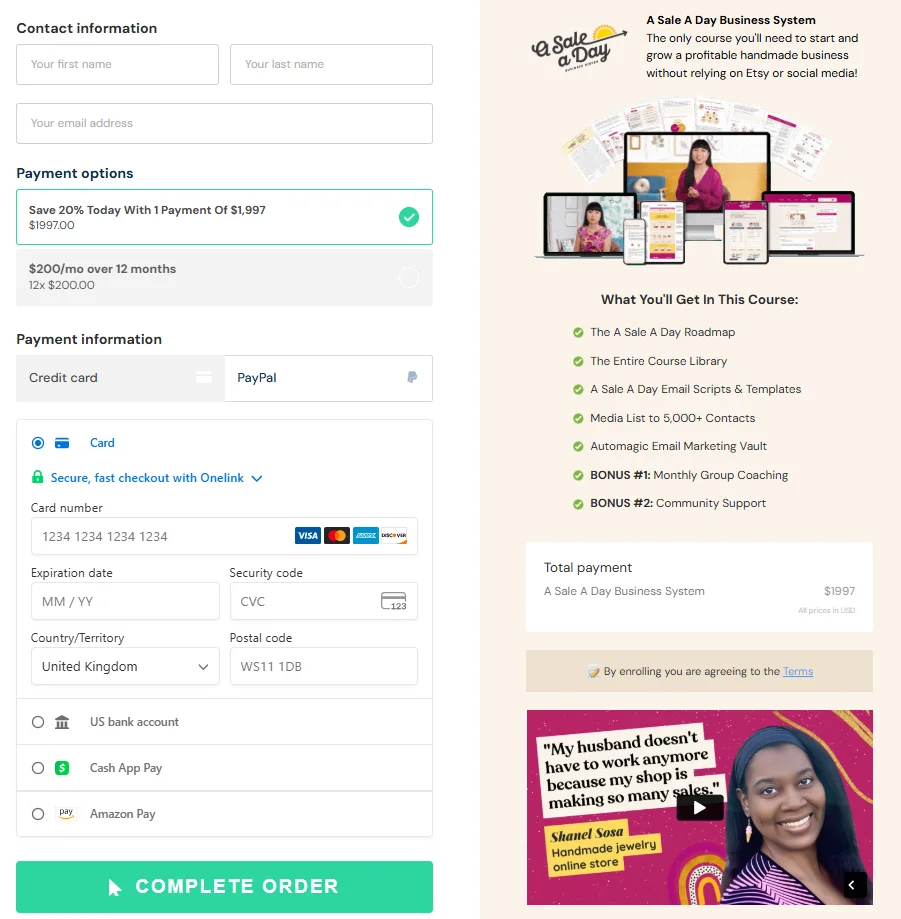
“The automations handle everything: adding students to my email list as customers, adding them to WordPress where they get access to the program,” she says. “It’s all automated, and it’s fast. There are no issues with it.”
The automations actually save Mei somewhere between 5-10 hours a month. “If ThriveCart didn’t offer that,” she says, “I’d have ended up paying a programmer thousands of dollars to stitch together all the different software.”
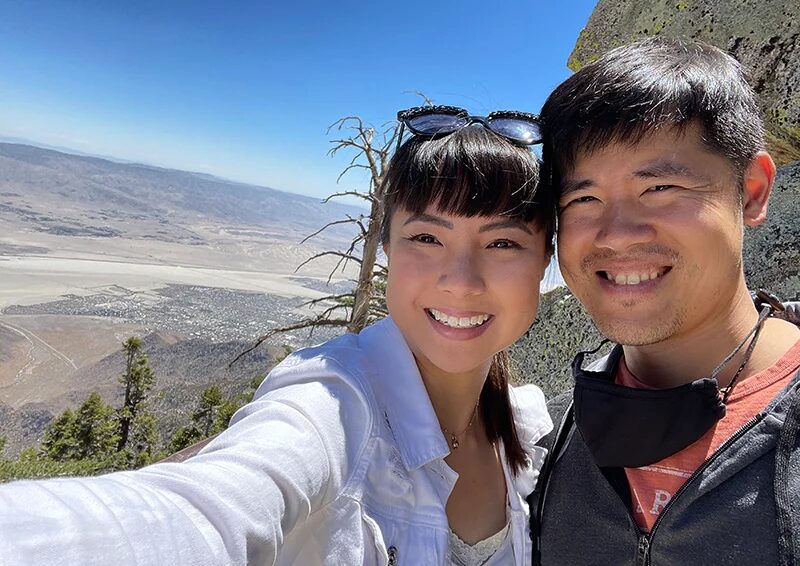
That efficiency isn’t just a nice operational win. For Mei and her husband Peter, it’s what makes the whole multi-business setup sustainable – and what’s given her something most entrepreneurs can only dream about: more time to focus on what she wants to.
“It’s very important to me that my students have a seamless, positive experience on the fulfillment side of things. I was very happy to see that it was so easy to set up in ThriveCart,” she adds.
Explore ThriveCart’s features, including order bumps, upsells, downsells, subscription management, course hosting, A/B testing, affiliate management, and more.

Mei’s advice for fellow entrepreneurs
 For any creator wondering whether their handmade business or creative passion can become a real business, Mei has plenty of encouraging advice.
1) Don’t wait to start pitching
“You are most likely more ready than you think you are,” she says. “Editors and media contacts don’t need you to have thousands of sales already. Being fresh and undiscovered can actually be an advantage. Just make sure your pitch is relevant and your photography is press-ready.”
2) Stop chasing social media metrics
“The amount of time I spent on social media in the early days was very disproportionate to how much money I was making,” she says. Follower counts and vanity metrics are seductive – but they don’t pay the bills. Earned media and email will serve you far better in the long run.
3) Don’t get comfortable on Etsy
Build your own checkout, your own list, and your own traffic. “Don’t put all your eggs in the Etsy basket,” she says. “Platforms can change their algorithms, their fees, their rules – and there’s nothing you can do about it. Your own infrastructure can’t be taken from you.”
4) It’s the small levers, not the big swings
Your progress compounds over time. “A lot of people are hoping for that one silver bullet that’s going to change everything,” she says. “But it’s really those small tweaks that stack over time that make the biggest difference.”
5) There’s always more you can do
Thinking of quitting? “I promise you there is always something else you haven’t done yet,” she says. “I have felt that hopelessness – multiple times in my journey. The people who tell me they’ve tried everything – 100% of the time – haven’t literally tried everything that’s possible. They’ve done everything they knew about. That’s different.”
