

Melanie Aubert was making great money. She was scaling a group coaching program to $500,000. She had 30 to 50 students at a time and a waitlist that kept filling. By most online business standards, she’d made it.
But those successes came with a price: she was on nine hours of calls a day, barely stopping to eat, and running on a model that left zero room for anything else in her life.
“At first when you’re starting online and you’re wanting to make money, that sounds like the dream – to be busy, to have students,” Melanie says. “But the reality of what that actually felt like was a complete nightmare.”
Melanie didn’t pivot because things weren’t working. She pivoted because the thing that was working was unsustainable – and she knew it. She’s a mom of two young kids. She wanted her business to complement her life, not consume it.
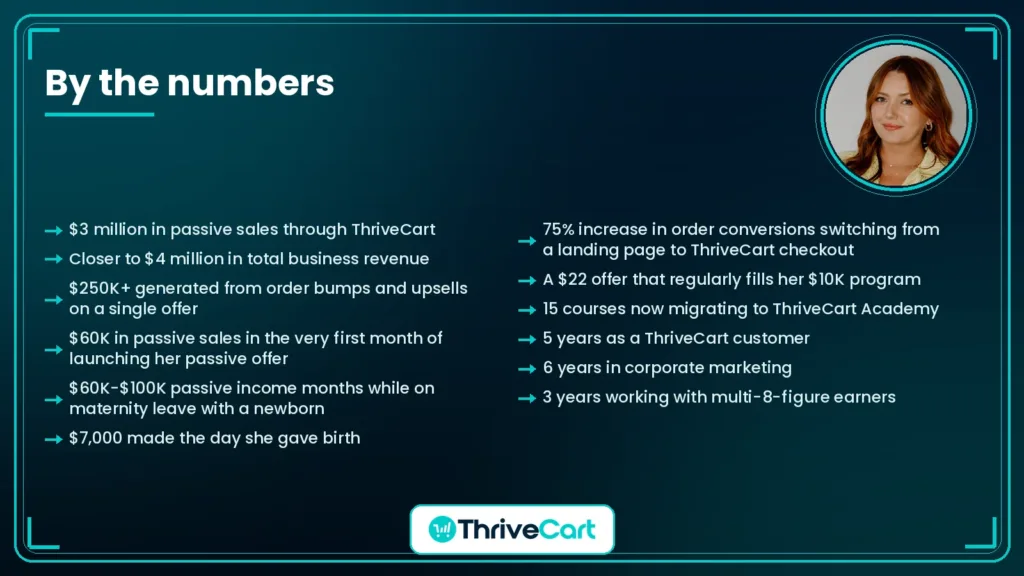
Today, she’s a business strategist who teaches what she calls “Compounding Cash” and passive income. She’s generated $3 million in passive sales through ThriveCart alone over the past five years. She’s had $60K-$100K months while on newborn duty. She made $7,000 the day she gave birth to her daughter.
Here’s how she got there – and why the platform she sells on made all the difference.
→ READ ANOTHER SUCCESS STORY | ‘From Burnout to $3 Million: How a Photographer Quit Her Camera and Built a Coaching Empire With ThriveCart‘
The burnout that changed everything
Before she became the person teaching passive income, Melanie was living the opposite of it.
Her background was in corporate marketing. She left that world because she saw the untapped potential of the online space and went all in. She built a large group coaching program and grew it fast. But the model was brutal. Three months of constant promotion, then deliver the program, then start again. Rinse, repeat, survive. “I had about 30 to 50 students at a time. I was on about nine hours of calls a day. I was lucky if I had a moment to take a bathroom break or even eat,” she recalls.
As a mom, she knew that model had a shelf life. “I always wanted my business to complement my life versus my life having to complement my business,” she says. “And it was constant calls, constant client work. It would have been impossible to sustain, let alone scale, with kids.”
The decision to change direction didn’t come from exhaustion alone. It came from data. Melanie monitors her clients’ success rates every quarter, looking for patterns. She noticed that the clients who mastered her content system the quickest were the ones who got results fastest. So she pulled out that content piece and built it as a standalone passive course.
“I didn’t even realize I was actually creating a passive income stream,” she says. “I just thought I was helping people succeed faster,” she adds.
She launched it through ThriveCart. Her first month of passive sales earned her $60K. “I had to work so hard to hit a $60K month with my group container,” she says. “It just flipped a switch in my brain. I knew I was on to something.”
→ HARNESS THE POWER OF RECURRING REVENUE | ‘The Freedom Formula: How Rob Cornish Turned Redundancy Into $41,000 a Month in Recurring Income‘
Why her previous platform wasn’t keeping up

The specific limitation that cost her the most? Kajabi didn’t have order bumps for years. Melanie watched other creators selling a single low-ticket course, generating one sale at a time, and thought: you could be making so much more money if you could introduce other offers alongside what they’re already buying.
Beyond that, Kajabi’s checkout customization was limited in ways that added friction to her whole process. She couldn’t add information or graphics in a way that felt cohesive, so she’d need a separate designer-built landing page just to link to the checkout. “With Kajabi, it was more frustrating because it took me longer to get things built,” she says. “Whereas in ThriveCart, it’s all there for me. I don’t need to be an expert at design.”
Her honest assessment of staying too long? “Just because everyone else is using it doesn’t mean it’s quality. I think people pushed Kajabi to other people because they wanted the affiliate cash and they didn’t really care for the actual platform. If you know it’s clunky and you’re just waiting for it to improve – don’t waste your time. It’s been years, and it still hasn’t.”
→ SEE ANOTHER SUCCESS STORY | ‘How a Self-Taught Mindset Mentor Consolidated 7 Separate Tools Into ThriveCart & Built a $2 Million Business‘
A happy accident: How she discovered ThriveCart
Melanie didn’t find ThriveCart through research or a recommendation. She was buying a content course through an ad when she noticed something felt different about the checkout. “I was like, ‘Oh, this design is nice.’ And the checkout was right there – how much it was, what the order bump was, all in one place. Then I saw how you could add an order bump. My brain’s already going: this is genius. Then there’s an upsell. Then, if you don’t want that, a downsell. And I’m thinking: this person is selling four offers at one time.”
She did the math on the spot. She estimated the difference in cashflow if she built out her own offers the same way. Then she moved her first passive offer over to ThriveCart and has never looked back.
→ MORE FROM THE BLOG | ‘How to Build a High-Converting Sales Funnel in ThriveCart (Quick Step-By-Step Guide)‘
The compounding that makes the whole thing work
What makes Melanie’s approach different from someone who just “has a passive product” is the way she sequences her offers to create what she calls a “buying frenzy” – where one sale naturally leads to more. “I will open my inbox and it’s one sale, and then there are seven other sales from the same person,” she says.
The engine behind this is ThriveCart’s order bumps, upsells, and downsells. When someone buys one of her offers, they’re presented with complementary ones at checkout – and those additional offers aren’t random. They’re designed to give the buyer a taste of everything else inside her world, creating what she calls “subconscious exposure” that makes future purchases an easy yes.
“My order bumps pay for my ad spend, so I’m always profitable,” she says. “Order bumps and upsells combined have created multiple six figures in cash for me – and I’m not even doing anything. It’s just there on the ThriveCart checkout.”
The results back it up. On just one offer, those order bumps, upsells, and downsells have generated over $250K. The first offer she launched on ThriveCart, a $67/month course has made over $750,000 alone. “Just that offer with people coming in and buying other offers, it’s changed my life. I couldn’t fathom having to make that in a group program format like I was in 2020,” she says.
She also tested running cold traffic directly to a ThriveCart checkout page versus a traditional landing page. The ThriveCart checkout converted 75% better. “People who were hot and ready to purchase got everything they needed right then and there,” she explains. “The price, the product mockup, what you get – all on the first screen. It felt less formal. It felt like: here’s the thing, if you want it, here it is.”
She also uses ThriveCart’s joint venture feature, which automatically pays out co-creators when a collaborative offer sells. No chasing, no manual transfers. It just happens.
→ HANDPICKED FOR YOU | ‘Simple By Design: How Lindsay Maloney Escaped the Launch Grind and Built a Multi-6-Figure Business With ThriveCart‘
A business built around a life, not the other way around
The numbers are impressive. What makes them meaningful is the context in which Melanie built them. She has two young children – a three-year-old and a nine-month-old. When she had her son, she was generating $60K-100K months in passive cash flow while figuring out how to be a new mom at the same time. The day she gave birth to her daughter, she made $7,000 through ThriveCart.
“My life didn’t have to change to make my business continue to compound and create cash for me,” she says. “Whereas if I look at my old model back in 2020 – I would have combusted.”
It’s not just about the money. It’s about what the passive model gives back: the ability to spend quality time with her kids without anxiously wondering how today’s revenue is going to happen. “I have no fear when it comes to waking up and being like, ‘How do I make money today?’ It’s just already happening for me behind the scenes,” she says. “I will wake up and there’s sales in my inbox. I will be making my kids breakfast and there’s sales in my inbox.”
→ RELATED READING | ‘Proof That Low Ticket Works: How Liz Wilcox Hit Nearly $2 Million With a $9 Membership and ThriveCart‘
Going against the grain (and being proven right)

When she first started teaching passive income and running low-ticket offers with paid ads, it was almost unheard of in her space. “Everyone was doing big group programs, masterminds, one-on-one. No one was doing low ticket with ads. People were organic only.”
She was told her $22 calculator offer was “too complex and not a great offer.” Yet it became her hottest-selling product on ThriveCart – and regularly fills her $10K program. “A $22 offer can fill a $10K space for me in record time,” she says. “It does that frequently.”
She also chose not to lean heavily on business coaches – another unpopular opinion. “I’d rather invest in platforms and a small team than an advisory or a mentor,” she says. “I do better when I’m in my zone of genius. People don’t always see what I see.”
The naysayers? They’ve come around. “They’ve all hired me in return,” she says. “So that’s kind of nice.”
→ YOU MIGHT ALSO LIKE | ‘Earned Media, Not Etsy: How Mei Pak Scaled From $3/Hour to Seven Figures and Freed Herself to Pursue Acting‘
Her advice for coaches and creators
If you’re still grinding through live launches or sitting on a platform that’s frustrating you, here’s what Melanie would tell you:
1) Diversify your cashflow sooner rather than later
Don’t wait until you’re burned out to build something that works without you. Start with a low-ticket offer designed to give people a quick win and a taste of your world. “Build it like a catnip formula,” she says. “They get a quick result, a quick win, a quick aha. They see their own potential within your world. That creates a very sticky client.”
2) Stop treating your checkout and funnel like an afterthought
This is where money is either made or left on the table. Order bumps, upsells, and downsells aren’t pushy – they’re just smart. “When I look at how much money people are leaving behind by not having a bump, an upsell, or downsell, it’s genuinely shocking.”
3) Don’t follow the crowd just because it’s the crowd
“Just because everyone else is using something doesn’t mean it’s quality,” she says. “Look at what your customer is actually experiencing on their end. If you know something’s clunky and you’re waiting for it to improve, don’t wait.”
4) Build low to go high
When it comes to offering low- vs high-ticket offers, Melanie says do both. “Build a low-ticket offer that creates a bridge into whatever your main thing is. Give them a taste. Make it easy to say yes. Then let the compounding do the rest. We see the online space teeter back and forth between ‘low ticket is the vibe’ and ‘high ticket is the vibe’. We hear about a trust recession. We hear a million different things. But to me, what has always stood the test of time, is people just want to know you and trust you. People need to trust themselves in your process.”
5) Go all in on your niche
Gain mastery over a singular topic, niche down, and then go all in on that, Melanie says. “Become known for that and don’t fall for all the hype around what business has to be because I was told moms can’t do both – we can’t be a present parent and also make a lot of money – and I’ve proven that wrong.”
Join Melanie Aubert and the 75,000+ entrepreneurs, creators, and coaches who use ThriveCart to power their checkouts, courses, affiliates, and communities.
