

When Melissa Guller launched Wit & Wire in 2019, she was still working full-time.
She started with one-on-one services while building her audience, then moved into building courses, mini products, paid funnels, live launches, evergreen programs, and higher-ticket offers. Today, she helps solo online business owners create simpler systems and programs that make their businesses easier to run.
But the business has changed significantly since those early days. The audience has grown. The offers have evolved. The way Melissa sells has shifted, too.
Throughout all that, one part of the business has stayed steady: ThriveCart.
“I like that I never have to worry about ThriveCart,” Melissa says. “It is one of, if not the longest-lasting tool that I’ve used in my business, and it can handle selling all kinds of products and services. So even as my business has grown, and either a market has changed or my preferences have changed, I was able to keep trying new things without always needing a new tool just to try something new.”
Here’s how Melissa built a business that could change without starting over, and how ThriveCart became the dependable foundation beneath every new offer.
A business that evolved with its audience
Melissa’s first offers were one-on-one services. At the time, she was selling her time while building an audience of online business owners.
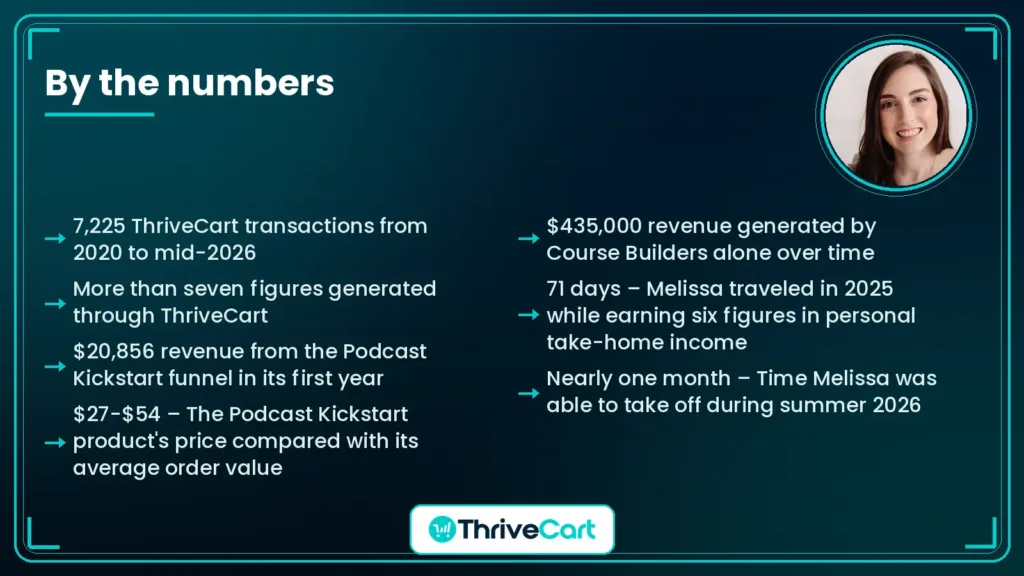
Her first $1,000 came when she had around 45 people on her email list, although some of those subscribers were family and friends, she recalls with a laugh.
“I think part of what’s enabled me to grow is the fact that I didn’t wait to start selling,” she says. “I just started selling from what I was able to do. In the beginning, for me, that meant selling my time.”
As her audience grew, her offers changed in response to what customers were asking for. Melissa first taught people how to launch and grow podcasts. As those courses became more successful, students started asking how she had created them. They knew about her experience at Teachable and wanted to learn how to build courses and programs of their own.
That led to Course Builders, one of Wit & Wire’s best-selling programs.
Melissa launched the first version in November 2021. She created a simple Notion page, linked it to a ThriveCart checkout, and started selling through conversations with her audience.
“I think from the time I decided I was going to launch it until I made the first sale was less than two weeks,” she says. “I sold out the first cohort of 20 students, and we met on a weekly basis over Zoom.”
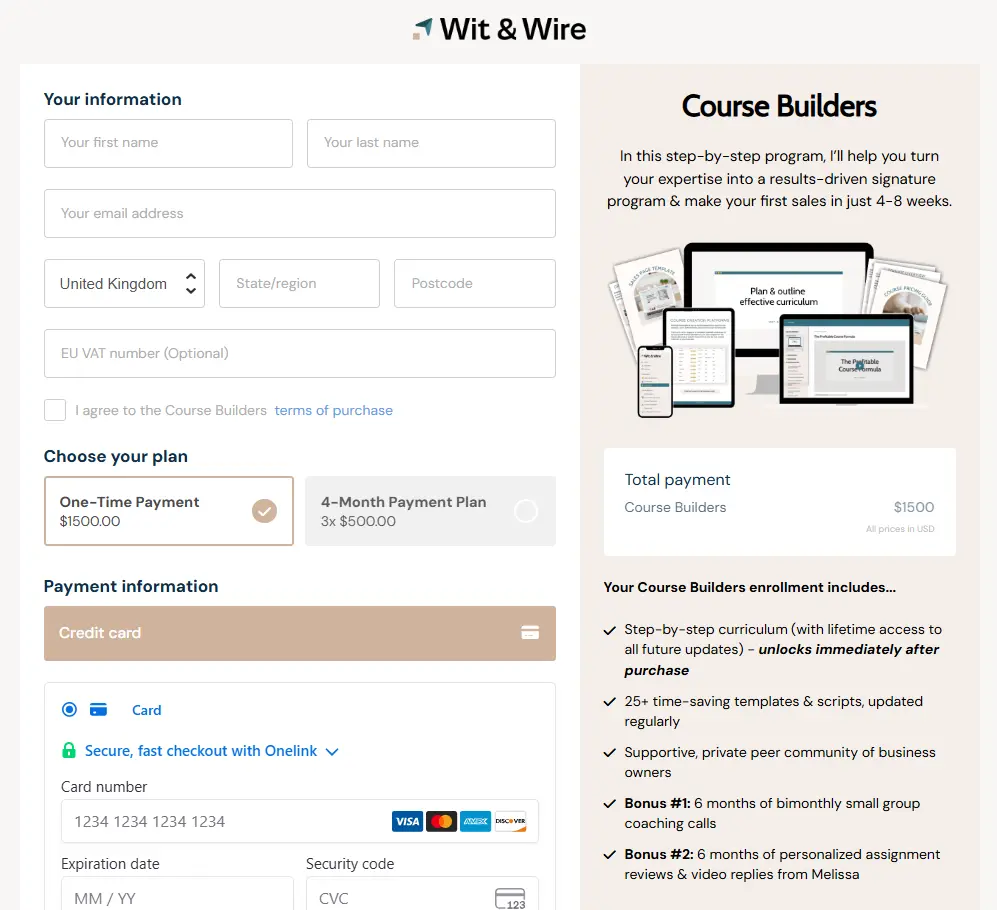
Course Builders eventually became a hybrid program with a mix of self-paced lessons and live, small group coaching sessions. Over time, it’s grown into a six-figure program, while continuing to evolve as the needs of online business owners change.
For Melissa, the lesson was clear: an offer doesn’t need to be over-built before it goes on sale. “I always try to put out new offers quickly before I build too much or get too invested,” she says. “One of the reasons my programs are so effective is because they’re built both from a place of my expertise, but also from what real buyers have told me that they need.”
→ READ ANOTHER SUCCESS STORY | ‘How Kelli Mitchell’s 30-Hour Workweek Selling Low-Ticket Offers Built a 7-Figure Creative Business‘
The $27 product that became a profitable funnel
Course Builders was a higher-value program built around a clear demand from Melissa’s audience. The Podcast Kickstart Program came from a different challenge.
At the time, Melissa had a $500 program that taught people how to launch a podcast. But many potential customers weren’t ready to buy it. They weren’t sure if their podcast idea was worth pursuing, what equipment they needed, or how to structure their episodes.
Instead of trying to convince everyone to buy the larger program, Melissa created a smaller product to help people make those early decisions.
The Podcast Kickstart Program cost $27 and was designed to be completed in less than a week. Melissa built the curriculum, workbook, course content, and sales flow in less than two weeks.
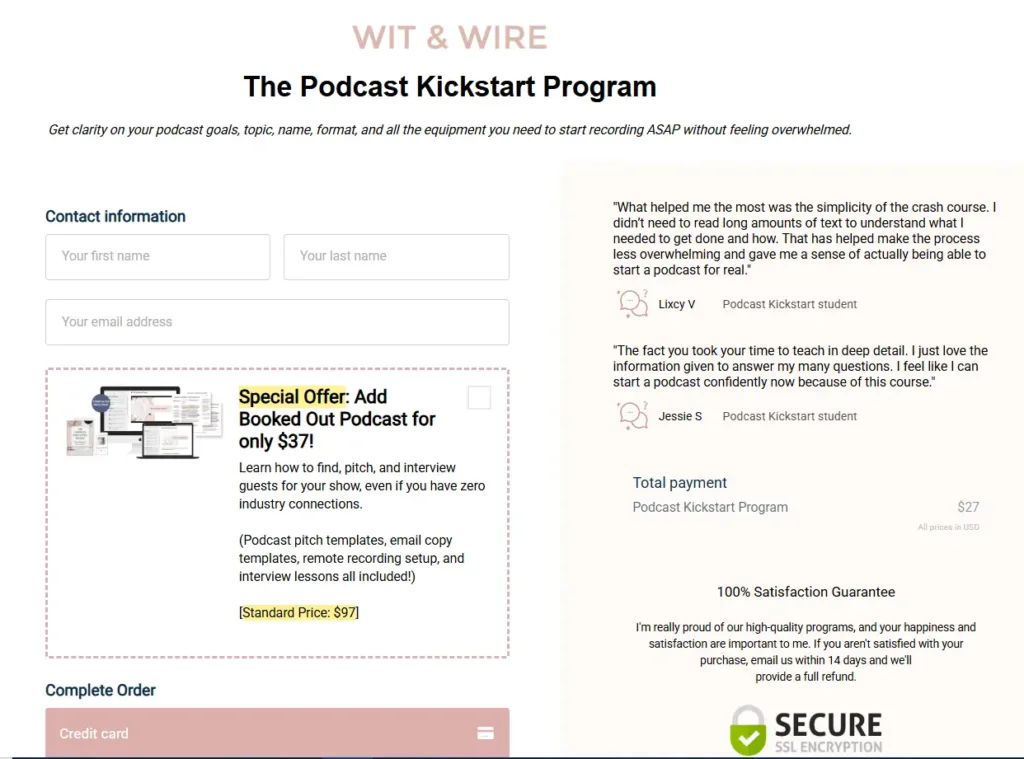
She first offered it to her existing email list. After seeing a positive response, she added paid advertising and used ThriveCart’s order bumps and upsells to increase the value of each purchase.
The results were significant.
The $27 product generated an average order value of $54. In its first year, the funnel generated $20,856 in revenue, added hundreds of email subscribers, and brought in customers who later purchased additional offers.
“ThriveCart’s ability to help me add products in the initial moment of purchase is huge,” Melissa says. “By the time somebody reaches a checkout page, I’ve already done all of the hard work of the sales and marketing that led to that point. Being able to put more useful products in front of them – with an order bump and upsell – when they’re ready to make a purchase makes a big difference in my business.”
The funnel worked because the additional offers were relevant. The order bump and upsell helped customers go further with the same goal, rather than distracting them with something unrelated.
Melissa believes that’s the right way to use these features.
“An order bump should solve a related problem,” she says. “It should feel obvious why it’s there, and it should be an obvious time-saver. The main offer should stand alone and get a great result without requiring somebody to buy the bump or the upsell.”
→ SEE HOW IT’S DONE | ‘Proof That Low Ticket Works: How Liz Wilcox Hit Nearly $2 Million With a $9 Membership and ThriveCart‘
Stability doesn’t mean doing the same thing forever
 Melissa’s business includes several types of revenue: one-on-one services, courses, group programs, downloadables, mini products, affiliate commissions, and partnerships.
She tracks these streams monthly, then looks more closely at the performance of individual products, evergreen funnels, and live launches.
For evergreen funnels, she reviews how many people enter the funnel and what percentage become customers. After a live launch, she compares the results with previous launches of the same product.
The goal isn’t simply to celebrate a good month or worry about a slow one. It’s to understand what the numbers are saying and decide what to do next.
That approach has helped Melissa build more predictable revenue without giving up the freedom to try new things.
“I haven’t started my revenue from zero in years at my business,” she says. “I have a baseline amount that I know I’m going to earn every month. That includes recurring payments from payment plans. It includes funnels that are evergreen or always on that I know will make a certain number of sales based on my audience size and what I do to market my business.”
When it comes to live launches versus evergreen sales, Melissa doesn’t believe businesses need to choose between. “Live launching gets a bad reputation, and I don’t want to do a live launch all the time because that’s exhausting,” she says. “But I don’t think live launches are bad, nor do I think evergreen is the only way to earn. Different strategies suit different business owners at different times.”
For Melissa, stability comes from having a mix.
It means that one launch doesn’t have to carry the entire business. It means there’s revenue continuing from existing payment plans and evergreen funnels. And it means she can plan her business around her life rather than forcing her life to fit around every launch.
→ YOU MIGHT ALSO LIKE | ‘How Dr. Destini Copp Runs Two Businesses (And Turns Free Events Into Over $600,000 In Real Revenue) With ThriveCart‘
Melissa’s advice for fellow entrepreneurs
 Melissa has three key pieces of advice for newer business owners and anyone going through a change.
Do things that don’t scale
In the early stages, personal conversations can be more useful than complicated automation. Melissa emailed people directly to ask for feedback and worked one-on-one with customers.
“Your business will have eras and chapters,” she says. “The things I was doing to earn my first $10,000 were very different from what I do today. When you’re smaller, you have advantages and superpowers that bigger businesses don’t have. Lean into the strengths that you have, do things that don’t scale, and automate later.”
Embrace experimentation
Some of Melissa’s ideas have performed better than expected. Others have flopped. She recommends treating each result as information rather than a judgment on your abilities.
“If something doesn’t sell well, it doesn’t have any bearing on my worth as a person,” she says. “Keeping that healthy separation is helpful. I like to have curiosity about what might work and pursue it.”
Start with the simplest version
A big vision doesn’t have to become a big project on day one.
Melissa suggests finding the simplest way to help customers get a result. That could mean teaching live over Zoom, working with clients one-on-one, or creating a smaller version of a larger program.
“Simple doesn’t mean low quality,” she says. “It can mean paring things down. Buyers don’t need bells and whistles. Buyers want results. Focus on the simplest things you can do in the beginning to help buyers get results.”
For Melissa, that approach has created a business that can grow without becoming rigid. Her offers can change. Her audience can evolve. Her interests can shift.
Through every stage, ThriveCart has remained the reliable backbone that helps Wit & Wire sell, adapt, and keep moving forward.
