SEO for Profit: How Nina Clapperton Built a Highly Flexible, $1M+ Business With ThriveCart
Last Updated: November 5, 2026
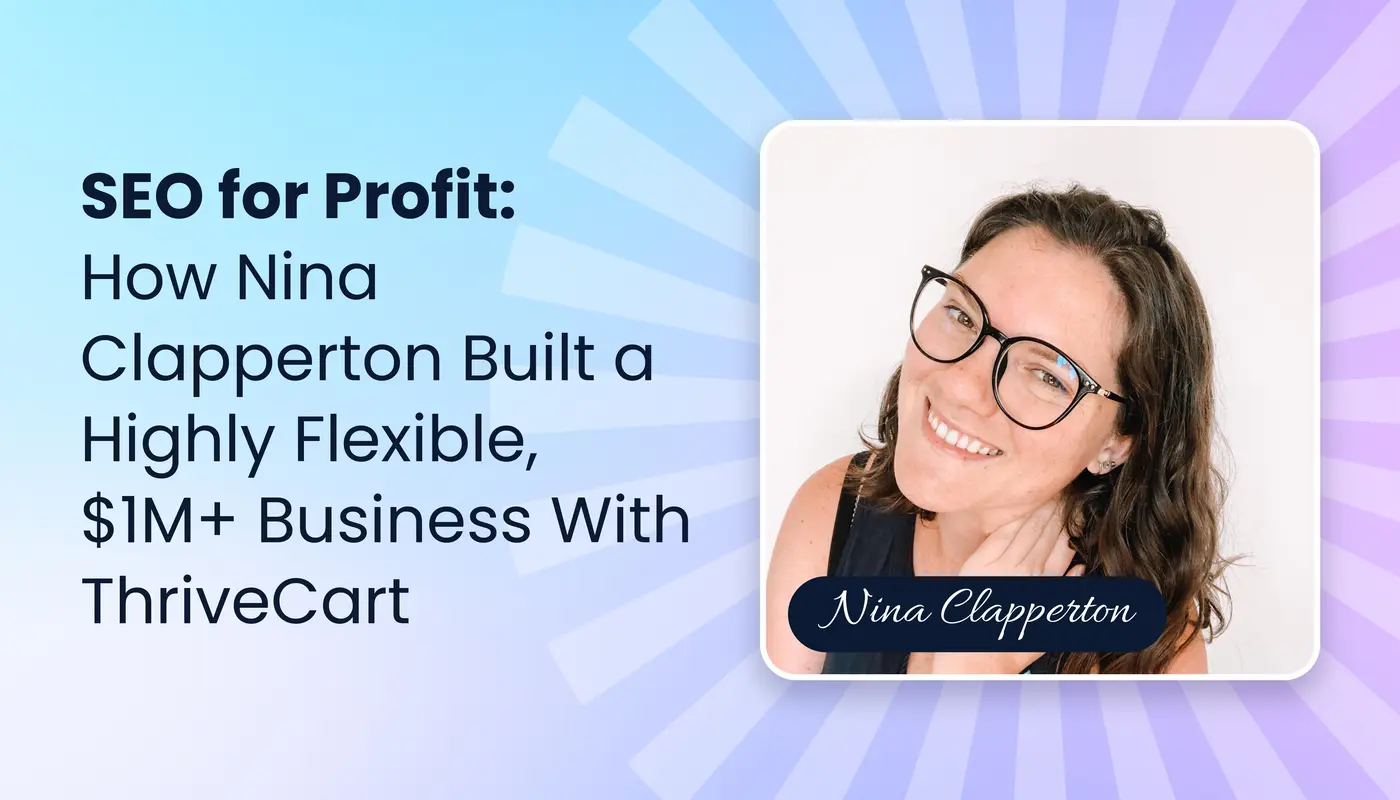

Nina Clapperton didn’t build She Knows SEO to create another business that demanded all of her time.
As a disabled and neurodivergent entrepreneur, she needed a business model that could give her structure without taking away her flexibility. She wanted the freedom to work when she could, rest when she needed to, and keep creating new products without rebuilding her entire tech setup every time.
Today, Nina runs 13 websites and sells a wide range of digital products, including SEO courses, ebooks, templates, AI tools, coaching, and her flagship Profitable Part-Time Blogger program.
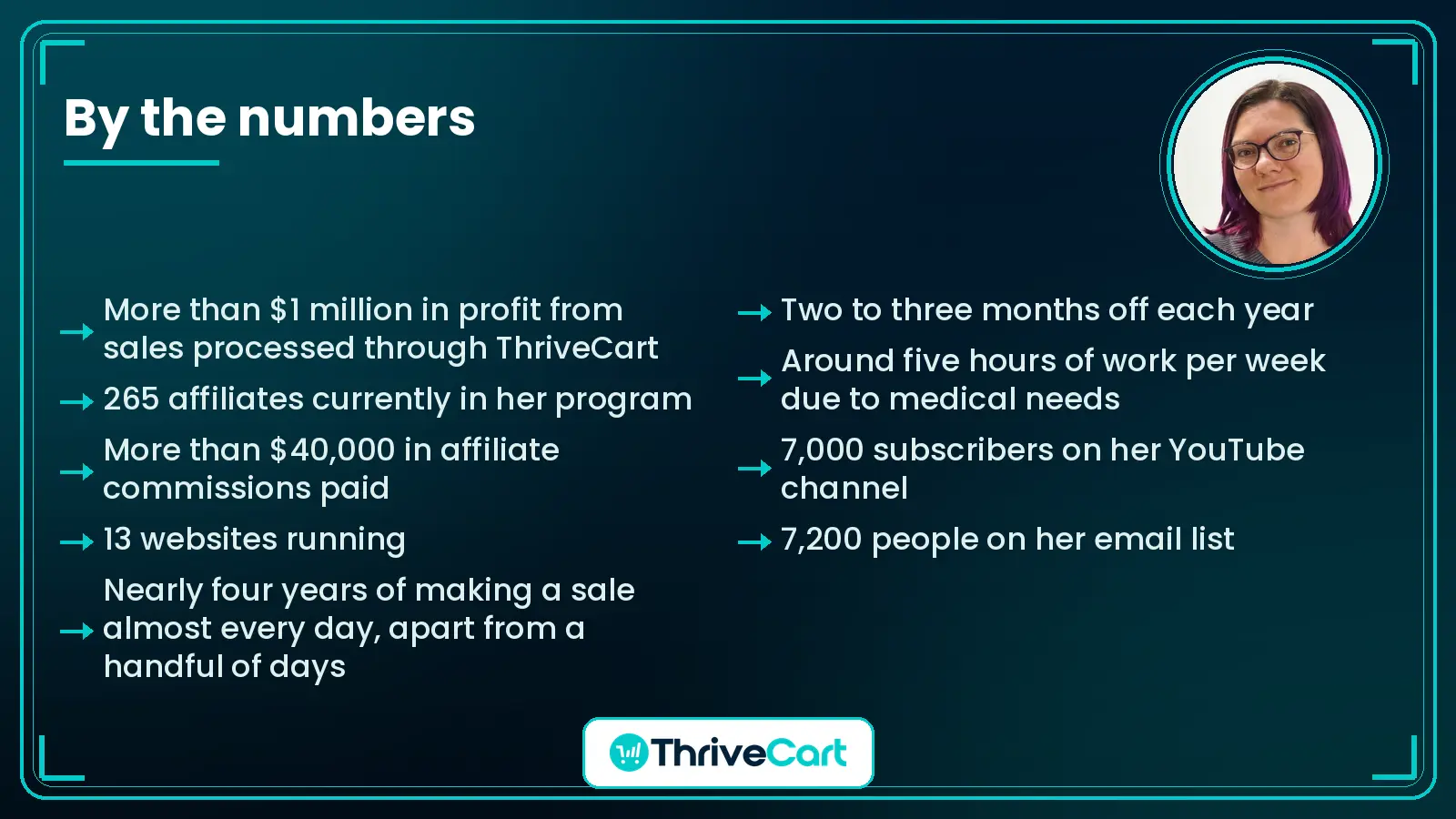
She’s also crossed more than $1 million in profit from sales processed through ThriveCart, excluding affiliate earnings.
The platform has helped her create a business that keeps working when she’s offline, including during an unexpected three-month medical leave.
“My version of success has always been happiness and contentment. I want a business where I have fun. My business ethos is ‘follow your fun’ – do what feels good and what you enjoy. Having the freedom to do that is so important,” Nina says.
Here’s how Nina built a flexible digital product business with ThriveCart at the center.
From SEO traffic to SEO profit
Nina’s business began with a travel blog.
She grew the site from around 5,000 monthly sessions to between 50,000 and 65,000 in just six months. That growth taught her how powerful SEO could be, but it also showed her that traffic alone didn’t guarantee a profitable business.
After months of work and publishing around 150 blog posts, Nina joined an ad network in the hopes of making a sustainable income from her blogging. Instead, she made just $1,500.
“It was a wake-up call,” Nina recalls. “It was proof that traffic could bring in money, but not enough money to justify the effort. If that’s not going to pay my rent, I’m not going to spend six months of my life just pushing for that over and over again.”
Nina started looking at online business differently. Instead of treating a website as a place where people arrived and left, she began using it as the starting point for a deeper customer journey.
She added affiliate offers, lead magnets, email funnels, and digital products. Her goal wasn’t just to attract visitors. It was to help them find the exact answers they needed, then give them a clear next step.
That approach led to a $26,500 month during her first Black Friday promotion. She also created two $7 products for her travel blog that went on to generate around $30,000 months while growing her email list.
The lesson was simple: the biggest audience isn’t always the most profitable one.
Nina’s first $100,000 month with She Knows SEO came when she had fewer than 10,000 monthly pageviews and around 800 people on her email list. “It was really about having that tight-knit community where I was answering things that literally no one else was,” she says.
That same focus now shapes the way she creates her offers. Her products are designed around specific problems, rather than broad topics that have already been covered thousands of times.
She Knows SEO helps people use SEO and AI to create profit, not just traffic. Nina’s audience includes many women, neurodivergent people, and disabled entrepreneurs who want practical support without being made to feel as if online business is too technical for them.
→ SEE HOW IT’S DONE | How a Self-Taught Mindset Mentor Consolidated 7 Separate Tools Into ThriveCart & Built a $2 Million Business
Why Gumroad, Teachable & Payhip weren’t the right fit
When Nina first started selling online, she tested Gumroad.
At first, the platform seemed like a simple way to get started. But as she worked through the numbers, the fees quickly became a problem.
“If Gumroad was taking 10%, I’m like, well, if I sell four of them, I may as well have just bought ThriveCart at that point,” she says.
The cost wasn’t the only issue. Nina also felt that the customer experience was too limited for the type of business she wanted to build. She wanted to sell courses and create a more organized, branded experience. Gumroad didn’t give her enough control over lessons, structure, or presentation.
Nina describes her ideal customer as someone who’s already busy and distracted. They may be trying to learn from a coffee shop, looking after their children, working a full-time job, or dealing with a noisy home environment.
“They’ve got 10% of their brain at most to give you, maybe 1%. I do not want to give them more work to do,” she says. “The whole point is that they’re paying me because I’m doing the work.”
ThriveCart gave Nina more control over the experience. She could organize course content, add transcripts, include private podcast episodes, write lesson notes, and adjust the look and feel of her products.
“I wanted it to be a luxury experience, and that wasn’t happening there,” she says of Gumroad.
She also compared the cost of using platforms such as Teachable and Payhip, which take a percentage of every sale. “I wanted to make sure that I wasn’t going to use some cheap platform and duct tape it together, and then it would fall apart,” she says. “Looking at what would work for my students and what would work for me, ThriveCart just made the most sense.”
→ READ ANOTHER SUCCESS STORY | 6 Years, Many Offers, 1 Backbone: How Melissa Guller Built a More Stable Online Business With ThriveCart

A platform that could change as the business changed
Nina’s business didn’t stay small or simple.
She began with courses and digital downloads, then added memberships, coaching, affiliate offers, AI tools, and products for several different websites. Throughout the changes, ThriveCart remains the core of her tech stack because she doesn’t need a new platform every time the business changes direction.
“ThriveCart has that flexibility,” Nina says. “I could add whatever I needed to the back-end. It allows for memberships, courses, digital downloads. I’ve even put freebies in there.”
That flexibility has helped Nina create repeatable systems for different types of offers.
She has a course template, a digital download template, saved sales page elements, forms for collecting feedback, suggested next steps, and ConvertBox pop-up elements already built into her setup. She can reuse those pieces instead of starting from a blank page every time.
“Setting it up took a bit of time, obviously, but now I get to be really lazy with it,” she says. “I’m proudly a lazy girl. With everything I do, I’ll spend 400 hours to get four more minutes napping with my dog.”

For a business owner managing disability and medical needs, that saved effort matters. Nina can create a new offer, build a checkout, set up delivery, and connect the necessary tools without having to invent the entire process again.
She also uses ThriveCart course hosting to make sure customers have a clear path after they buy. Course content, transcripts, lesson notes, private podcast episodes, and additional resources can all be organized in one place.
That makes the experience easier for customers and reduces the amount of support Nina needs to provide manually.
See one of Nina’s sales pages, with checkout, built in ThriveCart
→ ESCAPE THE CONSTANT LAUNCH CYCLE | From 9-Hour Call Days to $60K Passive Months: Melanie Aubert's ThriveCart Story
Exploring ThrivePages for SEO optimizations
Nina has been one of the earliest adopters of ThrivePages, ThriveCart’s new mobile-friendly checkout and funnel page editor.
She’s especially impressed with how easy it is to visualize the entire sales funnel. “I used to forget about the success page until I’d done everything else, and then not going to lie, I’d half ass it. Now I can see it so easily on the side.” she says.
She’s thrilled to have so many templates to choose from when building pages and says “they really help someone like me who isn’t great about visual set ups. It really gets me over the blank page syndrome.” Plus, she loves its mobile-friendliness, adding “it’s so much better than all these vibe-coded sales pages and carts with FAQs half in the margins so you can’t read anything. Now, I know that even on my laziest days where I just drag and drop and go, my checkouts will be usable for anyone on mobile!”
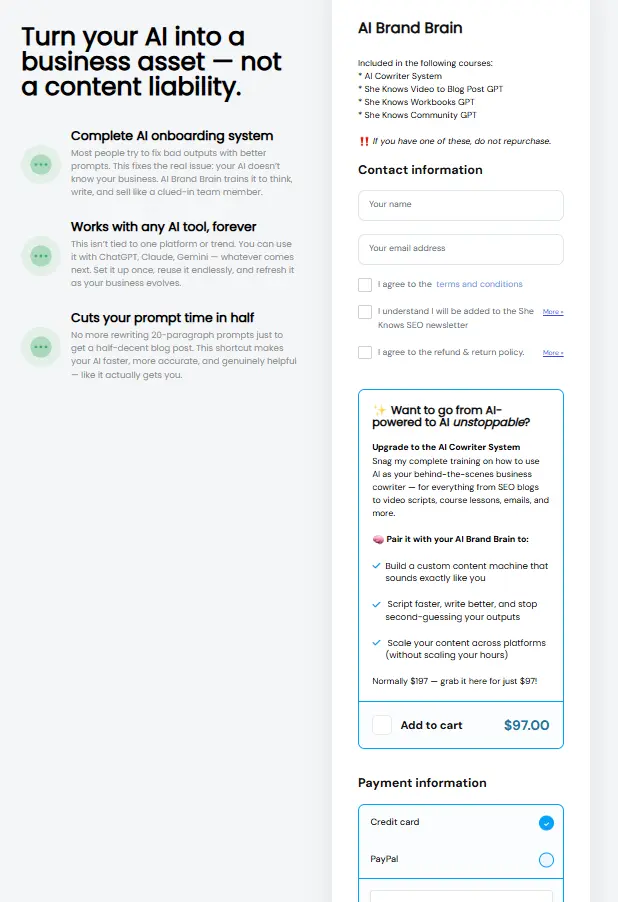
But the biggest thumbs up from Nina? ThrivePages’ SEO capabilities. “You’ve fixed my main gripe with these checkouts: the SEO! It’s so easy to adjust the SEO settings now and add custom code. So people can easily add product schema for their offers, and have their content indexed automatically,” she says.
Overall, says Nina, there was a bit of a learning curve, as you’d expect, but “All in all, I was able to get my checkout cart up and running in like five minutes. This used to be the hardest part of launching a product. Now, my checkouts are going to be so much easier. I also can’t wait for the extra AI features coming soon.”
→ EXPLORE MORE | The Freedom Formula: How Rob Cornish Turned Redundancy Into $41,000 a Month in Recurring Income
Affiliate tracking that rewards the whole customer journey
Nina has used ThriveCart’s affiliate tools since joining the platform.
She currently has 265 affiliates and has paid more than $40,000 in USD commissions. She also uses different currencies, including USD and CAD, and has created a branded affiliate center where partners can find links, offers, resources, and promotional materials.
Her affiliate strategy is built around relationships, not just one-off sales.
Nina wants affiliates to get credit when they introduce someone to her business, even if that person doesn’t buy immediately. An affiliate might send someone to a freebie or the She Knows SEO homepage, and that person might not make a purchase for months.
She has connected ThriveCart with Kit so those customer journeys can still be tracked. “I love that it can track through all of those things, so affiliates get the benefit even if the customer doesn’t buy straight away,” she says.
She also likes that future purchases can continue to be attributed to the original affiliate. That includes payment plans, subscriptions, and later purchases of other offers.
For Nina, this is fairer for the affiliate and easier for her to manage.
“When someone buys through an affiliate, ThriveCart makes sure the next purchases keep tracking,” she says. “For a payment plan, for a subscription, for the 10th offer that they buy, that original affiliate still gets the benefit, and I don’t have to try and remember who that person was.”
Nina can also search for affiliates by name, add them to a transaction, set tiered rewards, and deliver bonuses automatically.
Her affiliate program is intentionally selective. People can only join once they’ve purchased one of her offers, which means they understand what they’re promoting. Once approved, they can access her offers and resources without needing a separate sign-up for every product.
She also uses an affiliate hub with promotional information and AI-generated swipe copy that updates as her offers change.
→ RECOMMENDED READING | How Nicole Culver Scaled Past $4.3 Million With ThriveCart Checkouts Built in Under 60 Minutes
JV partnerships without the weekly admin
Nina also uses ThriveCart for joint venture partnerships.
She’s helped other experts create courses, co-hosted them, and shared the income through JV partner shares. Because she used to work in law, she prefers clear agreements and transparent reporting.
“Everything needs a contract. Everything needs to be super above board,” she says.
In the past, she could have used webhooks to move sales data into a spreadsheet, but she didn’t want to rely on a system that required either person to manually report the numbers.
With ThriveCart, both partners can see exactly what’s happening through the dashboard.
That transparency makes the partnership easier to trust, but it also makes it possible for Nina to take on these projects without creating a large amount of additional admin.
“I hate admin work,” she says. “If I had to go in and send them a weekly statement of how much they made and how much we sold, I wouldn’t do it. But because it’s automatically there in the ThriveCart dashboard, it’s so much easier.”
→ ANOTHER SUCCESS STORY | Rebuilding After a $10 Million Funnel Collapsed: How ThriveCart & Tripwires Helped Melissa Henault Return to 7 Figures in Just 17 Months
The dashboards that help Nina plan around her life
Nina loves being able to see her sales and analytics at a glance.

The reporting helps her understand revenue, payment plans, affiliate sales, customer journeys, and the products people buy over time. She can also see longer-term data instead of being limited to a short reporting window.
That visibility has helped her make better decisions about launches and future income.
“I want my data from the entire time I’ve been here, and ThriveCart does that,” she says. “That’s how I could see the one million, where I was like, yes, I’ve crossed it.”
Nina has also built her own dashboard that connects data from different parts of her business. ThriveCart helps show where customers came from, what they bought, how they moved through her offers, and how long it took them to purchase.
The result is a clearer view of what’s working, without requiring Nina to manually search through different platforms.
It also helps her plan around her energy and health. She knows which months tend to perform best, can account for payment plans, and can look ahead when she needs to take time away.
For Nina, this isn’t just about business growth. It’s about creating enough predictability for her to also rest.
She took three months of unexpected medical leave last year, and her business continued to generate income while she was offline. She now works around five hours per week and takes two to three months off each year.
“That’s success for me,” she says. “Not having to be in what I thought I had to be, which was a lawyer in an office hating my life.”
→ SHE ALSO TOOK MONTHS OFF WHILE STILL EARNING| Proof That Low Ticket Works: How Liz Wilcox Hit Nearly $2 Million With a $9 Membership and ThriveCart
Nina’s advice for entrepreneurs and coaches
Nina believes there’s still plenty of space for new businesses, even with changes in SEO, AI, and online marketing.
Her advice is to get specific, listen to real people, and avoid copying whatever happens to be popular online. “If everyone else is going down the exact same path, be like, I’m going to veer off a little bit,” she says. “You’ll find people who haven’t been able to be supported in the way that they need.”
She also recommends starting with the problems people are already asking about. Don’t create a generic product because it seems like everyone is selling one. Find the smaller, more specific problem that people are struggling to solve.
Finally, Nina says entrepreneurs should build a real business rather than chase the idea of getting rich quickly. “Don’t think of it as a get-rich-quick thing,” she says. “You have to think of it as building a business.”
For Nina, that business includes the offers, the audience, the affiliate relationships, and the systems that make everything easier to run.
ThriveCart gives her the structure to manage all of those moving parts, while still giving her the flexibility to build a business around her health, energy, creativity, and life.
“My favorite things about ThriveCart are the ability to have so many different types of offers hosted, and that it works for all of them because you can customize and templatize it,” Nina says. “And my other favorite thing is the affiliate tracking and the ease of everybody being able to see their income. Everything is very clear and it manages the payments that I don’t want to deal with.”
That combination of structure and flexibility has helped Nina grow She Knows SEO into a 7-figure business that keeps selling, keeps evolving, and keeps giving her more control over how she spends her time.
Ready to Scale Your Business With ThriveCart?
Create highly flexible, on-brand courses, checkouts, affiliate programs, digital offers, and more. Join Nina Clapperton and the 75,000+ entrepreneurs, creators, and coaches who use ThriveCart to power their checkouts, courses, and communities.
