Home > Blog > How to Price Your Online Course (And Stop Leaving Money on the Table)
Last Updated: July 28, 2026
How to Price Your Online Course (And Stop Leaving Money on the Table)
Written by
Jared Orlin
Table of Contents
You built a great course – excellent work! But now you’re staring at a blank pricing field, hovering between $97 and “maybe I should just make it free.” But that hesitation is one of the most expensive mistakes a course creator can make.
The global eLearning market was valued at USD 352.98 billion in 2025 and is projected to reach USD 1.48 trillion by 2033, growing at a CAGR of 19.9% from 2026 to 2033. That’s a massive, growing market full of buyers willing to pay real money for results. The problem isn’t demand. It’s that most creators price their products from a place of insecurity rather than a strategy, anchoring to the wrong benchmarks, underestimating their value, and leaving significant revenue behind. If you’re still deciding what to sell, start with our guide on how to sell digital products to find your best format first.
This guide gives you a practical, numbers-grounded pricing framework: real benchmarks by course type, a simple income-goal calculation, a tiered pricing model, payment plan mechanics, and how to pull it all together at checkout.
Key insights:
Many course creators underprice their courses by comparing themselves to free or low-cost content on course marketplace platforms, where thousands of sellers are competing on the same topics and pushing prices down for everyone.
Research shows that paying for a course, as opposed to taking a free course, leads to a rise in student engagement, meaning that charging appropriately actually serves your students better.
Offering three pricing tiers instead of one single price can increase your average order value without requiring any new core content to be created.
Payment plans remove the “big number” objection at checkout and typically increase conversions without permanently lowering your price.
Why your first instinct on price is usually wrong
The most common pricing mistake isn’t charging too much. It’s defaulting to a low number because you’re comparing your work to the wrong benchmark entirely.
The marketplace trap: Course platforms like Udemy, Domestika, and Coursera compete on volume and take a large cut of every sale. Thousands of instructors compete on the same topics, and sellers are constantly pressured to undercut each other. That dynamic pushes prices toward the floor. It has nothing to do with what a standalone course, sold directly to your own audience, is worth.
The YouTube anchor: Comparing your course to free video content ignores everything your course offers that YouTube does not: a structured learning path, a clear outcome, accountability, and your direct expertise organized into a format students can follow.
The self-doubt discount: Many creators lower their price because they don’t feel experienced enough or ready. But that’s just imposter syndrome influencing a business decision. Remember, your students aren’t grading you on how confident you feel; they’re buying the result you help them achieve.
The research backs this up. One study found that the act of paying for a course, or a free course with a paid certificate of completion, leads to a 10-12% rise in student engagement and follow-through.
In other words, the financial commitment changes the way students show up:
A higher course price isn’t just better for your business. In many cases, it genuinely serves your students better too.
Conversely, a lower course price doesn’t mean more students. In fact, it often means less motivated, less engaged ones.
Want a practical approach to course creation success? Discover one 7-figure seller’s blueprint for building a $100k course in just 60 days 👇
Online course pricing benchmarks by course type
Here’s what creators across the industry are commonly charging, organized by course format. These ranges reflect widely observed market pricing for independent courses sold directly to audiences:
Course type
Typical price range
What it typically includes
Mini course/workshop (1-3 hrs)
$47-$147
Quick-win skill, checklist-style outcome
Short course (3-8 hrs)
$197-$497
Skill-focused, structured modules
Flagship/signature course (8+ hrs)
$497-$2,000+
Comprehensive transformation, full curriculum
High-ticket with coaching
$1,000-$5,000+
Done-with-you, cohort access, or live sessions
Note that these ranges are not fixed rules. Several variables can push a course price meaningfully higher:
Niche specificity: A course on “B2B SaaS sales for early-stage startup founders” commands more than a general “how to sell” course, even if the core ideas overlap. The more precisely your course addresses a defined audience with a defined problem, the more you can charge.
Instructor authority: Your track record, credentials, case studies, and testimonials all increase perceived value before a buyer ever reaches the checkout page. Social proof is part of the pricing equation.
Outcome size: The bigger, more specific, and more measurable the result you promise and deliver, the more you can charge for it. “Feel more confident” is vague. “Close your first five enterprise clients” is a result people will pay to get.
Level of support: Live Q&A sessions, private community access, and direct coaching all justify significantly higher prices because they add accountability alongside information. Students know that access to you is finite and valuable.
One useful framework from online course strategist Chris Lema is the concept of pricing speed bumps.
🛑 These are the psychological thresholds where buyers naturally slow down and evaluate their decision more carefully: $100, $200, $500, $1,000, and $2,000.
✅ To reduce that hesitation, price just below those thresholds at $97, $197, $497, $997, and $1,997.
You keep your pricing strong while smoothing out the moment of decision for the buyer.
Set your price using an income goal, not a gut feeling
Before settling on a number, work backward from what you actually need your course to earn. This exercise is quick, clarifying, and often reveals that your instinctive price is lower than your business actually requires.
Here’s how it works:
Decide your revenue target. Say you want to generate $10,000 from your next launch.
Estimate a realistic conversion rate. A 2% conversion rate on your email list is a solid benchmark for a warm, engaged audience. Cold traffic converts lower. A highly engaged list may perform better, but 2% is a conservative and defensible starting point.
Divide the target by expected buyers. With an email list of 500 subscribers, you can realistically expect around 10 buyers. To hit $10,000 with that list, your minimum price would therefore need to be $1,000 per sale.
If that figure feels too high, you have two options:
Grow your audience before launching, so the math works at a lower price point.
Add more value to the offer so the $1,000 example price is clearly justified by what the buyer receives.
What you shouldn’t do is drop the price and accept a business model that doesn’t work and could leave you burnt out and in the red. Launching a course at $197 when the income math requires $1,000 isn’t a pricing strategy. It’s a problem deferred.
It’s also worth noting that this calculation gives you your floor, not your ceiling. If the math says $1,000 minimum but your offer, your expertise, and your niche could support $1,500 or $1,997, you’re leaving revenue behind by stopping at the minimum. The income goal exercise forces you to price for viability. The rest of this framework helps you price for what your offer is genuinely worth.
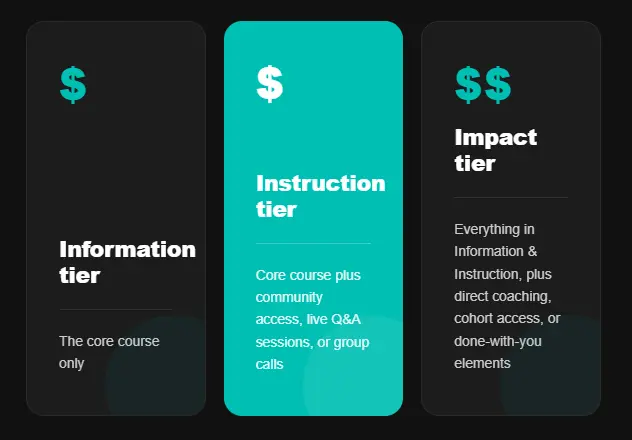
Offering a single price is one of the most consistent ways course creators leave money behind. A three-tier structure lets buyers self-select based on how much support and accountability they want. It also uses the anchor effect to make your middle tier feel like the obvious, well-priced choice.
Here’s the framework, built around what the buyer actually wants from the learning experience:
Information tier ($): The core course only, for self-directed buyers who want the content and will implement it independently.
Instruction tier ($$): Core course plus community access, live Q&A sessions, or group calls, for buyers who want structure and ongoing guidance alongside the material.
Impact tier ($$$): Everything above plus direct coaching, cohort access, or done-with-you elements, for buyers who want genuine transformation and are willing to pay for accountability.
In all three tiers, your core course content stays exactly the same. What changes is the level of access and support wrapped around it.
Here’s an example: a course creator initially offers two tiers ($600 and $1,200). They then add a third tier at $2,400. After restructuring, 49% of buyers choose the lowest tier, 27% choose the middle, and 24% choose the highest. The addition of a premium tier at the top shifts a significant share of buyers toward the middle tier and raises the average order value considerably without a single piece of new core content being created.
The premium tier doesn’t need to sell in large numbers to do its job. Its role is to make the middle tier look like a sensible, well-priced deal by comparison.
With ThriveCart’s high-converting checkout, you can configure tiered access, order bumps, and upsells directly at the point of purchase, without building separate landing pages or funnels for each package. Pair this with ThriveAcademy, our community-first LMS, and you’ve got all the tools to create online courses: course delivery, student communities, quizzes, gamification, learner forums, and more, all connected directly to your ThriveCart checkout and payment plan setup.
Payment plans increase conversions: here’s how to structure them
A $997 price tag will lose buyers who could comfortably afford $297 per month for three months. Payment plans don’t lower your price. They remove the “big number” objection by reframing how the buyer thinks about the financial commitment.
One tactic is to offer a three-payment plan. You could offer split payments and charge 1.2-1.4x your one-time price. Here’s what that looks like in practice:
One-time payment: $797
Payment plan: 3 x $297 (totaling $891)
Or use Buy Now, Pay Later (BNPL) options where you get paid the full amount upfront. If you go the first route, the installment premium compensates for the time value of receiving payments over 90 days rather than upfront, and accounts for a small number of failed or abandoned payment plans. It’s standard practice and buyers generally accept it without pushback when the premium is clearly visible at checkout.
Platform choice affects pricing flexibility too; see how payment plans work in our ThriveCart vs Kajabi comparison.
A few practical notes on setting up payment plans effectively:
Make the total installment cost transparent so buyers can see the full amount they will pay. Hidden costs at checkout erode trust.
Build a failed payment recovery sequence into your process. Declined cards are common and often not intentional on the buyer’s part.
Consider locking content access to completed payments if your platform supports it. This gives buyers a practical incentive to stay current with the plan.
ThriveCart handles payment plans natively at checkout. This includes split-pay and BNPL options, as well as our own BNPL solution, ThrivePay Installments, which is aimed at higher-ticket offers, including courses, usually priced $1,000+.
If your price feels high and conversions feel low, the answer is almost never to reduce the number. It’s to build more perceived value into the offer before you make any pricing adjustments.
Here are the most effective ways to do that without significantly increasing your workload:
Workbooks and templates: Practical, ready-to-use tools that help students implement what they’re learning in real time. These carry high perceived value and relatively low production cost.
Community access: A focused forum or group discussion space adds significant value. It also keeps students engaged and accountable throughout the course, which drives the completion rates that generate testimonials – and testimonials generate future sales.
Live Q&A sessions: Even a monthly 60-minute group call adds meaningful perceived value for most buyers because it signals ongoing access to you. Finite access to an expert is something buyers will factor into their decision.
Case studies and expert interviews: Third-party voices and real-world examples reinforce your credibility, add depth to the learning experience, and help justify a premium price point.
Certificates of completion: For professional development or skills-based courses, a verifiable certificate adds tangible career value. Research from the University of Michigan found that the prospect of earning a paid certificate was itself a significant motivator for course completion.
Build the perceived value up before cutting the price down. In most cases, adding one or two of the elements above will close the gap between what you want to charge and what feels justified, without discounting anything.
Pricing isn’t a one-time decision. It’s an optimization process, and your first course launch gives you real data that no amount of planning can replicate.
Here’s what to monitor after you go live:
Enrollment rate: If you’re converting well above your expected benchmark, your price likely has room to increase. If conversions are significantly below it, examine whether the issue is the price itself, the positioning on your sales page, or the size and temperature of your audience.
Refund rate: A high refund rate usually signals a misalignment between the sales promise and the course experience. Investigate messaging before lowering the price.
Completion rate: Low completion can sometimes indicate underpricing. Students who feel the financial weight of what they paid tend to engage more seriously with the material.
Student feedback: If students consistently say the course exceeded expectations for the price, that’s a clear signal that your price has room to grow.
Practical approaches to price testing:
Early-bird pricing: Offer your first cohort a lower price for a defined window. This creates launch urgency, rewards early buyers, and gives you a conversion benchmark before you move to full price.
Cohort-to-cohort comparison: If you run multiple launch windows, test different price points across launches with similarly sized audiences and compare conversion rates and average order values.
Tier testing: Introduce a new premium tier and monitor whether its presence shifts buyers toward your middle tier, which is the most common outcome when the anchor effect kicks in.
The key principle is to treat your price as a hypothesis, not a permanent commitment. Set a number based on your best available information, launch, observe the data, and adjust. Creators who set a price once and never revisit it are leaving compounding revenue behind with every subsequent launch.
Once your pricing is set, our step-by-step guide on how to sell digital products covers platform setup and marketing.
Q: How much should I charge for an online course? A: It depends on the format, your niche, and the outcome you deliver. Mini courses typically sell for $47-$147. Short courses range from $197-$497. Flagship courses start at $497 and can go well beyond $2,000. The most reliable starting point is to work backward from your income goal and cross-reference the market ranges for your course type.
Q: Is $97 a good price for an online course? A: For a short workshop or mini course, it can be appropriate. For a structured, multi-module course with a meaningful transformation at its core, $97 almost certainly undervalues what you are delivering. Test $197 or $297 before assuming the lower number converts better. For many coaches and creators, it won’t, and the price reduction could come at a significant revenue cost.
Q: Should I offer a free trial before charging? A: A free introductory module or lead magnet serves the same discovery purpose without conditioning your audience to expect the full course at no cost. Free trials on full courses can attract low-intent buyers and increase your refund rate.
Q: Can I raise my price after launch? A: Yes – it’s standard practice to do so. Early-bird pricing rewards your first cohort and creates urgency at launch. After that window closes, moving to full price signals growing demand and social proof. Students who enrolled at the early-bird rate are grandfathered in at what they paid.
Q: What is the best payment plan structure for an online course? A: A three-payment plan totaling 1.2-1.4x your one-time price is a widely used structure. It removes the friction of the full headline price without significantly reducing your per-student revenue, and it opens your offer to buyers who are motivated but cashflow-sensitive at the time of purchase.
Conclusion
Pricing your online course is a business decision, not a confidence test. Use the benchmarks in this guide, work backward from your income goal, structure your offer with at least three tiers, and make payment plans available at checkout. Then launch, watch the data, and refine.
ThriveCart is built to handle all of this natively: tiered pricing, payment plans, order bumps, and upsells, without needing to stitch together separate tools. Pair it with ThriveAcademy to host your course, build your community, and deliver the kind of structured, supported learning experience that justifies a premium price. Get started today.
Jared Orlin is a senior content leader with over 15 years of experience driving content strategy, brand storytelling, and digital marketing across the U.S., UK and South Africa. As ThriveCart’s Content Manager, he works with internal teams, including Leadership, Product, Engineering, Customer Service, and Support, to create clear messaging and updates around product updates, creator how-to guides, industry trends, and customer success stories.
Discover the simple evergreen sales system that helped Nicole Culver reach over $4.3 million in sales: selling more with simple checkouts, order bumps, and upsells.
Discover ThriveCart’s latest updates, including Academy upsell and downsell fulfillment, student progress stats, gamification, activity feeds, and ratings.
As part of our Creator Commerce: The ThriveCart Series, get expert advice from business coach Jenni Maroney on using AI to build a high-converting sales ...
As part of our Creator Commerce: The ThriveCart Series, social media expert Melissa Rodgers shares how to use Instagram content to build authority, earn trust, ...
Whether you’re launching your first offer or optimizing your 10th funnel, ThriveCart gives you the tools, control, and leverage to grow a business that’s built to last.